The Double Bottom of U.S. Policy Toward Hungary and Slovakia
National Interests or MAGA Interests?
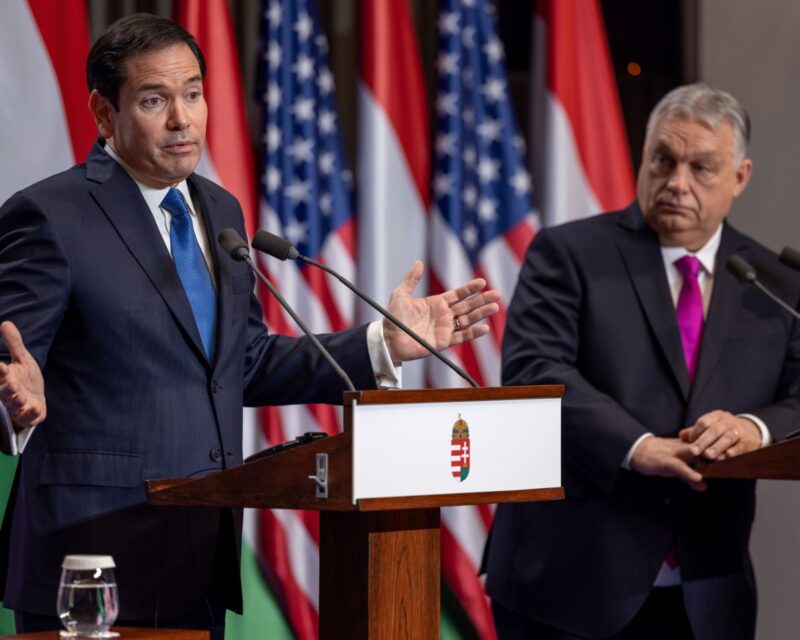
While Donald Trump provides the political – or rather MAGA – framework for relations with Hungary and Slovakia, Marco Rubio has sought to translate ideological affinity into industrial, energy and defense realities. The objective is not symbolic alignment but structural embedding – creating economic dependencies that outlast electoral cycles.
In Hungary’s case, this approach intersects directly with the political survival strategy of Viktor Orbán, who faces his most competitive electoral environment in over a decade, with Péter Magyar and the Tisza movement consolidating urban and middle-class discontent.
Yet events in Washington have complicated this strategy. Recent rulings by the U.S. Supreme Court limiting the scope and implementation of presidential tariffs have curbed the perception of Trump’s near-unchecked executive economic authority. The aura of omnipotence – central to Orbán’s geopolitical narrative – has been visibly dented.
The Nuclear Trade Off – Westinghouse Fuel
Hungary has explored a gradual shift toward U.S.-supplied nuclear fuel for the Paks nuclear power plant, reducing the monopoly position of Russia’s TVEL. Discussions reportedly include cooperation on dry fuel storage and frameworks for small modular reactors.
Symbolically, this signals diversification. Structurally, however, Hungary’s nuclear exposure remains overwhelmingly tied to Rosatom’s expansion of Paks II. The American footprint, if realized, would be incremental rather than transformative and far from primary.
The contradiction is clear: diversification rhetoric coexists with continued strategic nuclear dependence on Moscow.
The Energy Shield – Sanctions Waivers
Orbán has sought U.S. waivers protecting Hungary from secondary sanctions tied to Russian gas and oil imports via TurkStream and Druzhba. Crucially, these waivers require periodic renewal.
The leverage does not lie in pipelines but in financial clearing systems. U.S. sanctions architecture targets dollar-denominated transactions and insurance mechanisms. Control of financial plumbing equals geopolitical influence.
For Orbán, the domestic narrative is powerful: low Russian energy prices defended through American exemptions. The cognitive dissonance is obvious. Politically, it remains effective.
For Washington, however, annual renewal creates conditional leverage – a structural tether.
Support Independent Analysis
Help us keep delivering free, unbiased, and in-depth insights by supporting our work. Your donation ensures we stay independent, transparent, and accessible to all. Join us in preserving thoughtful analysis—donate today!
Military and Industrial Integration
Negotiations around HIMARS systems and potential cooperation between Hungary’s 4iG and Northrop Grumman point to defense-industrial embedding.
Defense contracts create long-term supply chains, technical dependency and elite networks. Unlike campaign promises, industrial integration tends to endure.
Yet the scale remains modest compared to Hungary’s deep structural integration within EU supply chains. US investments in Hungary are just $ 9 billion, compared to the EU’s $109 billion.
The Electoral Effect in Hungary
Rubio’s diplomatic engagement, even without dramatic breakthroughs, helps Orbán dismantle the narrative of isolation. If the electoral gap with Tisza narrows to statistical parity, symbolic validation from Washington can translate into 2–4% in swing segments.
However, recent U.S. judicial constraints on executive trade authority complicate Orbán’s messaging. If Trump cannot freely deploy tariffs or sanction tools as promised, the reliability of U.S. guarantees becomes less certain. Orbán’s strategy depends on projecting Trump as a geopolitical force multiplier. Any erosion of that perception weakens the Hungarian prime minister’s leverage narrative.
Meanwhile, investment realities remain stark. U.S. cumulative FDI in Hungary remains a fraction of total EU investment stock. The structural gravity of Hungary’s economy is European, not American.
Péter Magyar’s Counteroffensive
Magyar has framed Orbán’s approach as a substitution of dependencies: from Moscow to Washington.
His sovereignty argument is potent: If Hungary’s energy security depends on annual waivers from the U.S. Treasury, where is strategic autonomy?
Tisza also emphasizes corruption risks in defense-industrial deals, demanding transparency in agreements involving 4iG. The argument resonates domestically and among parts of the U.S. political establishment wary of oligarchic capture.
Magyar’s signaling to Washington is deliberate: Trump may be a friend of Hungary, but Orbán is a temporary partner. A future Tisza government, he suggests, would rebalance energy imports toward diversified LNG and deeper EU integration.
Slovakia: The Parallel Track
Though less visible internationally, Slovakia under Robert Fico follows a similar balancing act: rhetorical sovereignty, pragmatic engagement with Moscow, and cautious transactional alignment with Washington.
Bratislava observes Budapest closely. If Orbán secures structural U.S. concessions without EU retaliation, Fico may replicate elements of the model. If isolation follows, the lesson will be different.
The European Union’s Quiet Counter-Strategy
The EU’s dilemma before Hungary’s elections is calibrated restraint. Open confrontation would reinforce Orbán’s narrative of foreign interference.
Instead, Brussels relies on structural tools:
- Rule-of-law conditionality mechanisms
- Withholding and freezing of EU funds
- Audit and compliance pressure
- Political marginalization within European party families
- The latent possibility of Article 7 proceedings limiting voting rights
Significant EU funds remain frozen. This is not symbolic pressure; it is macroeconomic leverage.
If Orbán Wins Again
The strategic issue is not Orbán personally but systemic obstruction – blocking sanctions, Ukraine support, or budget decisions.
Possible EU responses:
- Circumventing vetoes through intergovernmental coalitions of 26.
- Intensified financial pressure.
- Gradual expansion of qualified majority voting in foreign policy.
- Multi-speed Europe discussions, marginalizing persistent veto players.
- Hard energy measures – restricting Russian transit routes – Turk Stream and Druzhba on top of a total ban.
- Invoking article 7 of the EU Treaty, restricting Hungary’s voting rights
The EU rarely reacts dramatically. It reacts structurally.
A Choice Between Transactionalism and Structural Integration
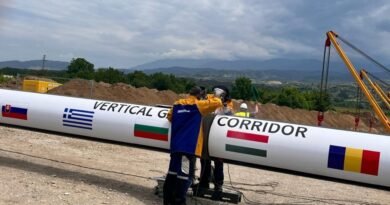
The ambiguity in U.S. policy between energy strategy and transactional diplomacy could hardly be starker. Slovakia and Hungary rank near the bottom among Central and Eastern European countries in purchasing U.S. energy, particularly LNG. Instead, both continue to rely heavily on Russian crude and pipeline gas, defending these imports as economically rational and politically necessary.
This exposes a widening gap between long-term U.S. national energy-security interests – which favor diversification away from Moscow – and the short-term logic of MAGA-era transactional alignment, where ideological proximity can outweigh structural energy realignment.
Trump’s foreign policy logic centers on leverage extraction rather than redistribution of collective gains. Orbán grasps this dynamic well. His engagement with Washington functions simultaneously as shield and bargaining instrument – a way to offset pressure from Brussels while preserving strategic channels to Moscow, which continues to provide financial and political ballast.
Yet the perception of Trump’s unbounded executive authority has been tempered. Recent U.S. Supreme Court constraints on tariff powers underscore that presidential economic tools are neither absolute nor immune to institutional checks. For Orbán, whose strategy partly rests on projecting alignment with a decisive and unconstrained White House, this introduces a layer of unpredictability.
Should Orbán secure another mandate and persist in obstructive tactics within the EU, the response is unlikely to be theatrical confrontation. More plausibly, it will take the form of gradual institutional narrowing – reduced influence, procedural circumvention, financial conditionality, and quiet marginalization.
Europe’s greatest risk is not overt fragmentation. It is decision-making paralysis.
And it is precisely against paralysis that Brussels has begun, methodically and without spectacle, to strengthen its systemic defenses.
Ilian Vassilev