
The Impossible Mission: Managing Russian Political Risk
How Bulgaria Turns Geopolitical Dependence into Business Risk
These days, it became clear that new metro trains for Sofia will be purchased from Škoda Transportation. The decision itself is logical – a European manufacturer, European technology, and an opportunity to gradually reduce dependence on Russian rolling stock.
But behind it lies a much more important question: why did Bulgaria have to wait for sanctions, war and the breakdown of relations with Russia to discover the obvious – that critical infrastructure cannot be built on dependence on a country that can turn into a geopolitical adversary at any moment?
Today, the problem appears technical – how to maintain Russian metro trains for which there are no longer normal channels for supplying spare parts, technology and servicing. But the problem is actually political. It is the result of a failure to manage Russia-related political risk.
And this is not an isolated case.
The same model lies behind the Belene Nuclear Power Plant, Bulgaria’s dependence on Lukoil and its Burgas refinery, the country’s long-term relationship with Gazprom, TurkStream, and a number of other strategic decisions.
The Fundamental Misconception: Russia Is Just Another Business Partner
For decades, Bulgarian policy treated Russia as a normal economic partner to which standard business-risk management tools could be applied.
That was the fundamental mistake. It is embedded almost genetically in the model of governance adopted in Bulgaria, which assumes from the outset that relations with Russia are a given – something Bulgaria cannot do without.
With ordinary business risk, you can assess the probability of changes in prices, demand, regulation, technology or financial conditions. With political risk, you can develop different scenarios.
But when your counterparty is a state that has consistently used economic dependencies as an instrument of foreign policy, the risk is of an entirely different order.
This is particularly striking at a time when Bulgarian politicians parade concepts such as multivector, multi-layered and multipolar foreign policy, while genuine diversification is missing precisely where it matters most – in relations with Moscow.
The basic questions should have been simple:
What happens if our relations, and those of our allies, with Moscow go south?
And, even more importantly:
Do we have a Plan B if Russia decides to cut supplies, servicing, technological support or access to critical components – either voluntarily or as a result of sanctions?
In Bulgaria, these questions were almost never asked when strategic decisions were being made.
Throughout the transition period, there is hardly a Bulgarian political leader who successfully addressed this issue – from Andrey Lukanov and Zhan Videnov to Rumen Radev and Boyko Borisov.
Even Ivan Kostov paid a price for this logic when he agreed to the privatization of the Burgas refinery by a Russian company, apparently as a way of balancing interests and keeping the “bear” invested in Bulgaria.
Belene: The Political Risk Was Right in Front of Us
The Belene project is perhaps the clearest example.
Bulgaria planned to build a nuclear power plant based on Russian technology and Russian reactors, creating a long-term dependence on Russia not only for the initial construction, but potentially for components, servicing, fuel and technological support.
If you create a dependency lasting for decades, you must be reasonably confident that you can forecast and manage the political risk associated with choosing Russia over that entire period.
Support Independent Analysis
Help us keep delivering free, unbiased, and in-depth insights by supporting our work. Your donation ensures we stay independent, transparent, and accessible to all. Join us in preserving thoughtful analysis—donate today!
In other words, you have to be confident that the ruler in the Kremlin will not eventually turn against your interests – or those of your allies.
The question was never whether Russian technology was good or bad.
The question was whether it was sensible to place critical national infrastructure, with a lifespan of many decades, at the mercy of a country with a fundamentally different geopolitical orientation and increasingly confrontational relations with the West.
That question was largely absent from the economic calculations.
Lukoil: When Dependence Becomes a Strategic Asset for the Other Side
The same logic was evident in the privatization and subsequent operation of the Burgas refinery.
From the perspective of conventional business logic, it seemed convenient for Bulgaria to have a major investor, a large refinery and secure oil supplies. Russia appeared to be a natural guarantor of both supplies and refinery-management expertise.
But the most important question was missing:
What happens if relations between Russia and the EU turn into a sanctions war?
That is exactly what happened. And suddenly an economic asset became a geopolitical liability, with potentially enormous present and future costs. The state then had to search for a way out of a dependency it had itself allowed to accumulate.
Gazprom: The Lesson That Was Never Learned
The most revealing example is the deliberate creation of Bulgaria’s dependence on Russian gas.
In April 2022, Gazprom unilaterally halted gas supplies to Bulgaria, even though Bulgaria had financed and built, with its own resources, one of Russia’s most important strategic infrastructure projects – TurkStream – through which Russia bypassed Ukraine.
The central argument on the Bulgarian side had been that this infrastructure would make Russia dependent on Bulgaria and therefore prevent Moscow from cutting supplies.
Yes – but no.
The dependency turned out to be asymmetric. Bulgaria could not even use the transit of Russian gas as an effective countermeasure because of its own contractual and financial obligations.
This should have been the moment of final recognition:
Dependence on Russia is not leverage over Moscow. It is leverage for Moscow over Bulgaria.
Yet even after this shock, Bulgaria continued to bet on Russian gas transit, even at the risk of alienating the European Union and running up against its planned total ban on Russian gas imports after September 2027.
This is the fundamental difference between managing a business and managing geopolitical risk. A business can be profitable in a normal environment. But if that environment depends on the political will of the Kremlin, profitability does not eliminate the risk. It merely postpones it. And there can come a moment when the losses explode into the stratosphere regardless of mitigation plans.
That is what happened with Belene. Bulgaria’s attempt to conduct “business as usual” with Russia has already cost it close to €2 billion in sunk and irrecoverable costs.
The attempt to manage Russian political risk through the Lukoil refinery has also generated enormous costs – including foregone tax revenues, lost profits and the economic consequences of sanctions. The cumulative exposure runs into several billion euros.
The Impossible Mission
This brings us to the central argument.
No one can reliably manage the political risk generated by the Kremlin.
No one ever has, and no one will in the future.
Not because Russia is unpredictable every single day, but because its decisions do not necessarily follow the logic of economic or geopolitical rationality as understood in conventional business planning.
If even major European countries, with vastly greater intelligence, economic and analytical resources than Bulgaria, failed to anticipate the scale of Russia’s aggression against Ukraine and the subsequent destruction of economic relations, how could Bulgaria possibly have done so?
The answer is simple: It could not.
In fact, if there is one thing that can be predicted about Russia, it is that Russia tomorrow can still remain unpredictable very much like Russia today and yesterday.
Expansion and unpredictability are embedded in the logic of an empire whose political system has repeatedly failed to establish a stable domestic model capable of guaranteeing prosperity and security for its citizens. Then domestic political failure becomes impossible to contain, the regime repeatedly resorts to exporting tensions and conflict.
Therefore, the right strategy is not to try to manage Russian political risk, which is impossible, but to avoid creating critical dependencies whose risks we cannot manage.
Risk Must Be Managed Before the Investment
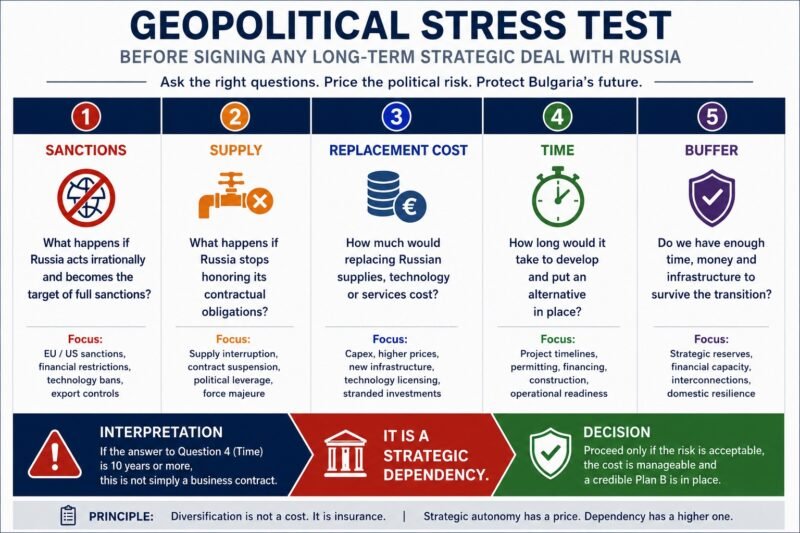
This means that every strategic project should undergo a mandatory geopolitical stress test.
Before signing a long-term contract, at least five questions must be answered:
· What happens if Russia takes an irrational decision and becomes subject to full sanctions?
· What happens if Russia, due to exogenous or endogenous factors, stops honoring its contractual obligations?
· How much would it cost to replace Russian supplies?
· How long would it take to develop and put an alternative in place?
If the answer to the last question is “10 years”, then this is not simply a business contract. It is a strategic trap. And it must be assessed as such.
Diversification away from Russian risk is therefore not merely a cost. It is insurance.
If you have no Plan B and no adequate buffer of resources and time, finding an alternative at the last minute will not only be cost-prohibitive. Sometimes it will be impossible.
That is precisely what happened with Belene.
The Bulgarian Government’s Problem Is Not Russia
The Bulgarian Government’s problem is not the Kremlin per se, because it simply has no effective leverage over its decisions. It is the way Bulgaria assesses Russia – and the way successive Bulgarian governments have approached the forecasting and management of the risks and opportunities arising from relations with Moscow.
That is the real problem. For decades, the question was: “How can we do business without Russia?” making it mandatory to transact with Russian companies.
After 2022, the question should be: “How do we ensure that, if Russia changes its behavior, Bulgaria will not pay the highest possible price for having ignored the political risk?”
That is an entirely different philosophy.
And this is why the story of the new metro trains is not a minor technical glitch. It is yet another reminder that geopolitical dependence has a price – but that price is often paid years after the political decision that created the dependency.
The impossible mission is not solely to predict what the Kremlin will do.
It is to stop treating Russia as a special case that can be exempted from the normal rules of strategic risk management.
The real strategic objective should be:
Build Bulgaria in such a way that whatever the Kremlin decides, Bulgaria does not have to pay for it.
And that should be the test applied to every major strategic investment from now on.
Ilian Vassilev


