Analyses & AlternativesFEATURED

Lavrov’s Message to Radev: Keep TurkStream Flowing – Or Else?

Moscow’s shrinking diplomatic space

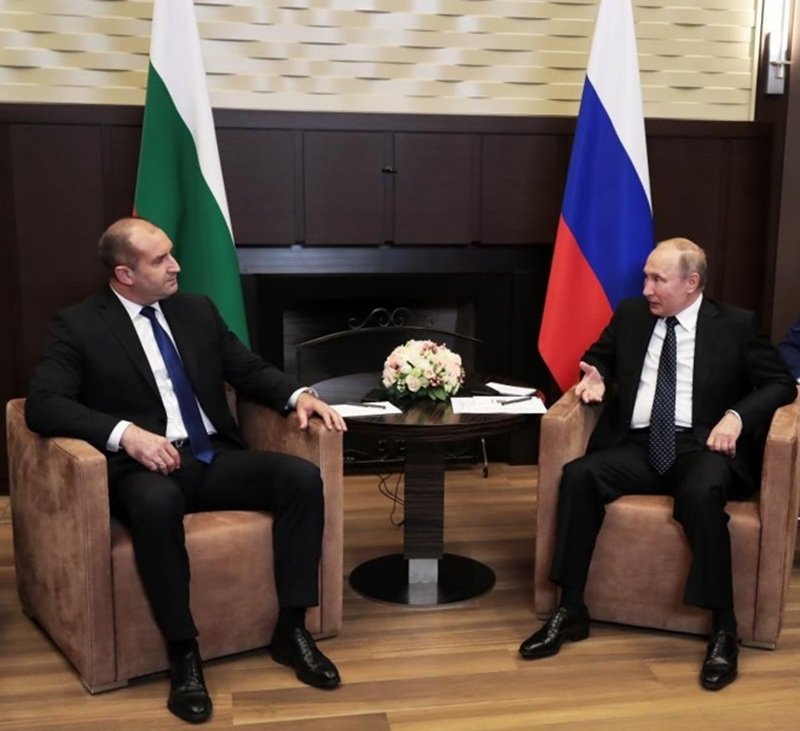
What did Russian Foreign Minister Sergey Lavrov actually tell Bulgarian President Rumen Radev yesterday?

On the surface, it was a diplomatic statement. Look more closely, however, and a different message emerges.

Russia’s diplomatic room for manoeuvre has shrunk dramatically during the war. In practice, the Russian Foreign Ministry is increasingly becoming an instrument of signaling and propaganda rather than active diplomacy. Putin has left it little space to operate: he does not want peace, and he does not want a ceasefire. Ergo, there is little room for diplomacy – the cannons do the talking.

Lavrov and the Foreign Ministry have therefore increasingly turned to one of the few tools still available to them – information and psychological operations, or, more simply, propaganda.

But Lavrov’s remarks also contain signals that deserve to be decoded.

Bulgaria was singled out for a reason

First, Bulgaria was singled out from the other EU member states, which went unmentioned, and contrasted with what Lavrov called the “Brussels bureaucracy”. That is itself a signal.

Moscow expects Sofia to play a specific role. And that role is not abstract.

Second, Lavrov effectively said it in plain language: you have a job to do, and it is not done yet.

And time is running out.

Why is Bulgaria important enough to receive such explicit attention from the Russian foreign minister?

The answer, once again, is TurkStream.

TurkStream remains a strategic Russian asset

TurkStream is central to Moscow’s strategy for preserving Russian gas exports to Europe and maintaining leverage over European energy markets.

The pipeline was delivered under Borisov in the original political bargain: Bulgaria built the infrastructure, while Moscow, in effect, benefited from the political arrangement that kept Borisov in power.

The political circumstances have since changed.

Radev is now in power, and Moscow’s expectation is that he will help preserve the continued flow of Russian gas through TurkStream into Europe for as long as possible, despite the EU’s decision to phase out Russian pipeline gas by autumn 2027. Under the EU’s current rules, remaining Russian pipeline gas imports are to end by 30 September 2027, with limited provisions for exceptional extensions.

The stakes are high. The EU has drastically reduced its dependence on Russian gas – Russian gas imports fell from 152 bcm in 2021 to 36 bcm in 2025. Pipeline gas alone fell from 137 bcm in 2021 to 18 bcm in 2025 – effectively all via the TurkStream.

For Moscow, the issue is therefore no longer simply selling gas to Europe. It is preserving the physical and political infrastructure that could keep Russian gas reaching European markets for as long as possible.

And Bulgaria is critical to that infrastructure.

It is the EU gateway.

The Russian narrative frames the obstacle as the “Brussels bureaucracy”, as if an unelected bureaucracy were arbitrarily shutting down Russian gas flows.

The reality is different.

The EU member states have collectively adopted a policy of progressively eliminating Russian energy dependence as part of a broader effort to reduce Moscow’s capacity to finance its war and to remove a major source of strategic vulnerability.

For Moscow, this is not a technical regulatory dispute.

It is a critical threat to one of its remaining energy channels into Europe.

More than $8 billion a year

The economic dimension is substantial.

Russian gas worth more than $8 billion a year passes through Bulgaria on its way to European markets.

That makes TurkStream far more than a pipeline.

It is a strategic revenue channel for Russia, an instrument of energy and diplomatic leverage, and a critical part of the remaining physical infrastructure connecting Russian gas to the European market.

This also helps explain why Bulgaria can suddenly receive unusually direct attention from Lavrov.

The issue is not Bulgaria’s weight in geopolitics.

It is Bulgaria’s position on the energy map.

The message behind the message

Seen from this perspective, Lavrov’s statement can be read as a political message rather than simply a diplomatic comment:

Radev, you have a job to do.

The objective is to resist, delay, otherwise complicate or circumvent the European effort to eliminate Russian gas flows through Bulgaria and to preserve the strategic utility of TurkStream.

This also explains why Moscow needs Bulgarian political actors who present EU energy policy as an imposition by “Brussels”, rather than as a collective policy adopted by EU member states in response to Russia’s war.

And this is where Bulgarian domestic politics becomes relevant.

If the current political leadership fails to deliver the desired outcome, Moscow has other political instruments available.

The most obvious is Kostadin Kostadinov and Vazrazhdane, which has consistently opposed sanctions on Russia, criticised EU energy policy and defended closer relations with Moscow.

This does not require a crude theory of direct Russian command and control.

Influence is often far more effective when it operates through political incentives, compatible narratives and domestic actors who already have an interest in advancing the same positions. GRU-engineered explosions and Novichok attacks are far less effective – and far harder to disguise.

The real test for Radev

This creates a very concrete test for President Radev.

Is his policy toward Russian gas genuinely driven by Bulgaria’s national interest, market considerations and European energy security?

Or is Bulgaria once again being positioned as a political weak link through which Russia can preserve an important route to the European market?

The answer will not be found in speeches.

It will be found in decisions concerning TurkStream, Bulgarian gas infrastructure, Russian gas flows, EU restrictions and the future allocation and use of pipeline capacity.

That is why Lavrov’s remarks deserve to be read carefully.

They may sound like another attack on “Brussels”.

But underneath the rhetoric lies a much more concrete message:

Keep TurkStream alive. Keep the gas flowing. Deliver results before the European window closes.

For Moscow, this is not really diplomacy.

It is about preserving its last European strategic gas asset.

For Sofia, it is a test of whether Bulgaria’s energy policy is being determined in Bulgaria – or whether the country is once again being asked to play the role of a Trojan horse within the EU.

Ilian Vassilev

Leave a Reply

Your email address will not be published. Required fields are marked *