Lukoil: A Nationalization Bill Disguised as Expanded Powers for the Special Administrator
As expected, the turf war over Lukoil’s departure from Bulgaria has turned ugly. The more Sofia’s ruling coalition recognizes its dependence on decisions made abroad – and its own limited capacity to act – the more erratic its behavior becomes.
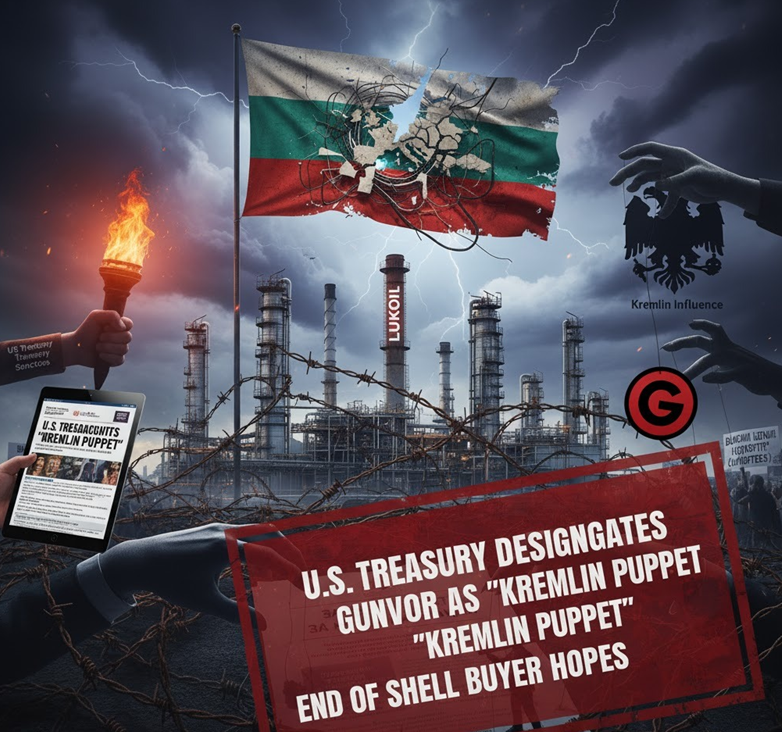
When the U.S. Treasury described Gunvor as a “Kremlin puppet,” it effectively ended any lingering hope in Moscow that Lukoil’s Bulgarian assets could be retained through shell buyers or friendly intermediaries. The company’s exit is now only a matter of time. But the U.S. sanctions regime, while squeezing Russian energy firms, has left governments like Bulgaria in an awkward position—deprived of legal cover for outright nationalization yet compelled to intervene to sustain the operations of a strategic asset.
US and EU energy giants have shown no interest in acquiring these holdings, leaving Sofia with a stark choice: risk a buyout by new Kremlin proxies or step in itself.
A Legal Minefield
The draft law before parliament effectively grants the government’s “special administrator” sweeping powers to manage – and potentially dispose of – Lukoil’s Bulgarian assets, while suspending the majority shareholder’s voting rights. Such measures may well contradict Bulgaria’s Constitution.
Support Independent Analysis
Help us keep delivering free, unbiased, and in-depth insights by supporting our work. Your donation ensures we stay independent, transparent, and accessible to all. Join us in preserving thoughtful analysis—donate today!
President Rumen Radev, who has consistently defended Lukoil’s ownership rights, is almost certain to veto the bill and refer it to the Constitutional Court. If he does, Bulgaria could be trapped in a legal limbo where Lukoil formally retains ownership, while the state assumes de facto control – freezing operations and paralyzing the fuel market.
A prolonged standoff could lead toward forced idling and suspending the company’s status between two incompatible realities: private property and public control.
The “Nuclear” Option—and Its Traps
Nationalization may appear to be the “nuclear option” to prevent Lukoil from transferring its assets to disguised Kremlin proxies after the failed Gunvor deal. But the way Sofia is pursuing it—rushed, opaque, and politically charged—risks doing more harm than good.
A single misstep could cost billions of leva and destabilize Bulgaria’s already fragile energy market. Even with expanded powers, the special administrator will remain dependent on Lukoil’s existing management, which holds the refinery’s technical and operational know-how. Without a qualified team to replace or supervise that management, state control could quickly turn from a safeguard into a source of asset value destruction.
Timing Is Everything
The timing of government intervention is critical. It makes a world of difference whether Sofia steps in after Lukoil is no longer able to operate under sanctions, or whether it acts preemptively while the company is still functioning normally.
If the latter occurs, Lukoil could cast itself as a victim of arbitrary expropriation – a narrative that would find traction in courtrooms and among skeptical European partners. Domestically, pro-Russian politicians could exploit public anger over potential price hikes to stir anti-Western sentiment and destabilize the government.
It is a different matter altogether if Lukoil itself fails to sustain refinery operations. In that case, a state takeover would be both legally defensible and economically necessary.
A Familiar Bulgarian Drama
Behind the rhetoric of “decisive action in the national interest,” a familiar pattern reemerges: shadow bargaining and mutual dependence between the state and entrenched oligarchic interests. Lukoil may formally depart, but the power networks that sustained its dominance for two decades remain intact.
Unless managed with surgical precision and full transparency, Bulgaria’s “nationalization” of Lukoil risks becoming not a break with the past—but its repetition in a new form. Once again, the old adage applies: Lukoil never truly loses, and the Bulgarian state never truly wins.
Ilian Vassilev