Why the Bulgarian Section of the Trans-Balkan Gas Pipeline Remains Idle — and Why It Matters for Ukraine and Europe
photo: LinkedIn
Recent agreements between Greece and Ukraine have renewed attention on the Trans-Balkan Gas Pipeline (TBG) and its potential role in supplying non-Russian gas to Ukraine. Greece’s DEPA and Ukraine’s Naftogaz have signed a winter LNG supply agreement involving U.S.-origin cargoes routed from the Alexandroupolis FSRU northward toward Ukraine. A parallel long-term memorandum between Naftogaz and Atlantic-See LNG — a joint venture between DEPA and the Greek construction group Aktor — envisages LNG supplies through Greek terminals well beyond 2050. Both rely on the Trans-Balkan corridor through Bulgaria, which makes the current status of the Bulgarian TBG segment central to understanding what is feasible — and what is not.
The Facts
The claim that gas is already flowing to Ukraine through the Bulgarian section of the TBG is incorrect.
- Configuration of the TBG on Bulgarian territory:
The TBG consists of two transit lines crossing Bulgaria toward Turkey and connected to Romania via the Kardam–Negru Vodă 2 and 3 points. Today, not a single cubic meter flows through these transit lines. - Misleading communication by Bulgartransgaz (BTG):
BTG has repeatedly implied that the TBG operates in reverse mode. In reality, reverse flow exists only on the former Kardam–Negru Vodă 1 interconnector — now part of BTG’s domestic grid — whose entry and exit points connect exclusively to Bulgaria’s internal transmission network, not the transit system. Hence, it is not part of the TBG.
Obstruction of Non-Gazprom Flows
This is not a technical nuance. It goes to the heart of whether Bulgaria can facilitate emergency and sustained winter supplies to Ukraine.
Since prioritising TurkStream as its flagship project, BTG’s leadership has consistently obstructed options for moving non-Gazprom gas through the TBG’s two transit lines. To enable full reverse flow, Bulgaria needed to restore transit capacity lost when a key segment between CS Lozenets and CS Provadia was repurposed exclusively for TurkStream. This required a compensatory 63-km looping section between Rupcha and Vetrino.
Instead of addressing this strategic chokepoint — critical for any meaningful diversification away from Russian gas — BTG redirected its investment focus toward comparatively marginal projects:
- expanding the already underutilised Sidirokastro–Kulata interconnector;
- building an additional loop inside the domestic network to serve the needs of an oligarch.
Meanwhile, Romania-bound capacity needed for Ukraine remains unavailable. Four years after TurkStream’s commissioning, the essential Rupcha–Vetrino looping has still not been built and is now optimistically scheduled for late 2026.
The IGB and Sidirokastro–Kulata Interconnectors
Two entry points enable U.S. LNG arriving at Greek terminals to flow into Bulgaria:
- the Greece–Bulgaria Interconnector (IGB), operated by ICGB;
- the Sidirokastro–Kulata interconnector, operated by BTG.
The concept of bundled, harmonised reverse-flow tariffs on the Vertical Gas Corridor was initiated by IGB, whose increased utilisation depends on stronger northbound flows into Romania. After IGB cut its winter tariffs by an extraordinary 46 percent — compared with roughly 25 percent by BTG — it became clear that the true bottleneck is not at the border but inside Bulgaria’s network: the missing Rupcha–Vetrino loop.
A quiet but unmistakable competition is unfolding between:
- actors aligned with Russian gas interests, who designed, financed, and operate the Bulgarian section of TurkStream and who are interested in sustained Russian gas flows to Hungary and then to Ukraine; and
- supporters of non-Russian alternatives, including Azeri gas and U.S. LNG via Greek terminals via the Vertical Gas Corridor.
Because the IGB is the engine behind the Vertical Corridor, it has become a growing irritant to the coalition that controls TurkStream capacity. The same actors have obstructed the restoration of TBG’s reverse-flow capability and repeatedly delayed the expansion of the Chiren underground storage facility — both of which should have been treated as urgent priorities since the start of the war.
Toward Real Flows to Ukraine
Geopolitical pressure resulting from Russia’s war on Ukraine has forced system operators to improve coordination. Real opportunities now exist to move LNG — including American LNG — from Greece to Ukraine, and several commercial deals are already taking shape.
As noted, the entry capacities at Kulata and IGB are sufficient to absorb LNG volumes delivered to Greek terminals. The constraints are internal to Bulgaria’s grid and linked to insufficient short-term storage capacity at Chiren. The restart of the Alexandroupolis FSRU further expands options — particularly for IGB — but Bulgaria’s current network cannot fully support simultaneous high-capacity use of both Revithoussa and Alexandroupolis.
Support Independent Analysis
Help us keep delivering free, unbiased, and in-depth insights by supporting our work. Your donation ensures we stay independent, transparent, and accessible to all. Join us in preserving thoughtful analysis—donate today!
This explains why the TurkStream-aligned group (the so-called Gazprom’s friends group) seeks control over IGB: limiting its expansion would protect the status quo around the Kulata route and preserve dominance of Russian-linked flows.
Consider the Numbers (BTG official data)
- Kulata entry capacity: 2.3 bcm/y today; BTG plans an increase to 3.3 bcm/y
- IGB entry capacity (Stara Zagora): 3 bcm/y today; expansion to 5 bcm/y planned
Route selection within the Vertical Gas Corridor depends on the chosen entry point and the internal transmission costs to Bulgaria’s northern border. Revithoussa must also meet Greek domestic demand, while Alexandroupolis is designed primarily for re-exports — making IGB strategically vital.
Geopolitical Context and Conclusions
The idle Bulgarian section of the TBG — with 17 bcm/y of unused capacity — is the single largest dormant transmission asset in Central and Eastern Europe. Restoring it could fundamentally reshape regional security of supply and Ukraine’s independence from Russian gas.
The links are clear:
- Russia systematically attacks Ukrainian energy infrastructure.
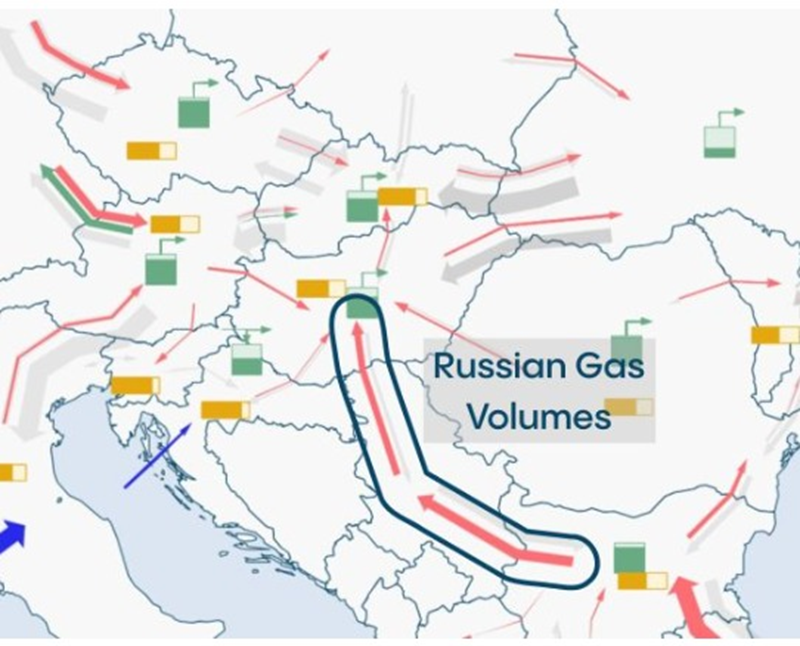
- Russian gas flows to Ukraine via Hungary and TurkStream are increasing.
- Hungary and Slovakia continue warning of “Armageddon” if Russian gas stops.
- Simultaneously, efforts intensify to constrain non-Russian flows along the Vertical Gas Corridor.
Russia never targets Ukraine’s gas system entry points from Hungary — but repeatedly strikes infrastructure tied to imports via Romania and Moldova, including drone and missile attacks on the Orlovka metering station. Orlovka is critical for Azeri gas and LNG entering Ukraine via Greece, Bulgaria, and Romania.
Today, Ukraine’s largest gas imports come from Hungary — roughly 10 million cubic meters per day — supplied entirely via TurkStream and therefore entirely Russian in origin. This compares with 8 million cubic meters from Poland and 6 million from Slovakia.
By delaying restoration of TBG’s northbound capacity, BTG effectively privileges Russian flows through TurkStream over non-Russian options on the Vertical Corridor.
The IGB has long been a strategic obstacle for the TurkStream coalition, which has attempted multiple times to seize control. With the expectation of a more permissive geopolitical environment under a second Trump administration, these actors appear to believe a new window of opportunity has opened to take control over the IGB.
Ilian Vassilev