
Trump-Assisted: Putin’s New Cognitive Offensive in Europe
The Kremlin has sharply escalated its cognitive warfare — and this time, the stakes are far higher.
Moscow now markets every minor tactical gain in Ukraine as a strategic breakthrough. A one-kilometer advance becomes “a hundred.” Kupyansk, Volchansk, Pokrovsk are regularly declared “captured,” in open defiance of facts on the ground. Positions held briefly are cast as “historic victories.” This is not improvisation; it is doctrine. The Kremlin understands that today’s real front is informational — that psychology now matters as much as artillery. When battlefield results disappoint, propaganda fills the void.
What is more troubling is the mobilization of Moscow’s proxy network across Europe and beyond — a spectrum ranging from paid propagandists to well-meaning but misled commentators. These propaganda “waves” reliably intensify whenever Jared Kushner or Steve Witkoff hint at real or imagined progress in their negotiations with Moscow. Most of this is unverifiable — and that is precisely the point. The ambiguity provides the Kremlin with fresh ammunition for psychological operations against Ukraine and Europe.
Large segments of the public are increasingly unable to distinguish fact from fiction. Each day brings new “reports” that the Ukrainian front is collapsing, that General Gerasimov has seized yet another city, or that the Kremlin’s “restraint” in not taking Odesa is some act of strategic mercy. None of this is supported by verifiable data from the front line. But relentless repetition delivers exactly what Moscow seeks: doubt, hesitation, and creeping demoralization.
Mainstream international media — including in Bulgaria — amplify this effect. In pursuit of an elusive “balance” and outdated notions of journalistic neutrality, they disproportionately highlight corruption and dysfunction in Ukraine while ignoring the essential distinction between a democratic state fighting for survival and an authoritarian one prosecuting a war of conquest. Many journalists have grown oddly deferential to orchestrated “leaks,” evasive briefings, and narrative-shaping by anonymous officials — thereby strengthening Moscow’s hand. The Kremlin’s line is always the same: Russia should negotiate only with the “real players” in Washington, with Ukraine and the EU relegated to the sidelines. Vanity remains the most reliable access point into Donald Trump’s worldview; Europe and Ukraine struggle to keep pace with Putin’s “secret messages.”
Support Independent Analysis
Help us keep delivering free, unbiased, and in-depth insights by supporting our work. Your donation ensures we stay independent, transparent, and accessible to all. Join us in preserving thoughtful analysis—donate today!
Adding to this chorus are the usual American “freelance military experts,” Steve Hanke, Jeffrey Sachs, retired officers, and others who have drifted into the Kremlin’s orbit. Yet new data from the annual Reagan Institute survey show a clear gap between what some in Trump’s circle are pushing and what Americans actually believe. A recent Ronald Reagan National Defense Survey tells a different story to the one Trump and his MAGA team try to sell – support for a Ukrainian victory among Americans has risen nine points to 62 percent. NATO enjoys record approval — 68 percent, versus 34 percent disapproval. And at the very moment Kushner and Witkoff engage in secretive talks with Putin, a remarkable 70 percent of Americans say they do not trust Russia or its security guarantees.
So why do these pro-Russian voices in Washington continue to defend Putin and justify Russia’s war?
The explanation is depressingly banal: money, notoriety — or both. Add to that the hunger for recognition, the search for new sponsors, and ideological residues for which Russia provides a convenient vessel. Most of them hardly bother to hide it. The universal excuse is always the same: “We live in a material world.”
Europe’s Leaders: Why the Silence?
Why do European leaders — many of whom privately concede that “the U.S. is no longer a reliable ally” — still refuse to say so publicly and reach out the majority Americans that do not trust Vladimir Putin? Why can they not articulate the obvious: Donald Trump is not merely withholding support for Ukraine; he is actively amplifying Russia’s information and psychological operations.
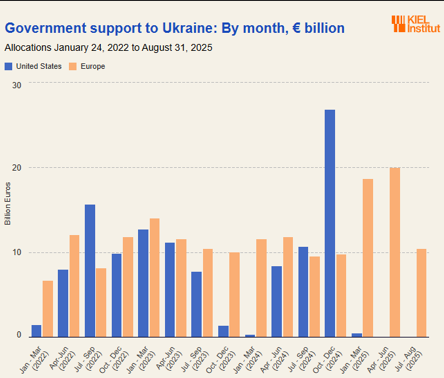
Whether Trump is consciously aligned with Moscow is almost irrelevant. The practical effect is the same. His actions serve Putin’s strategy: freezing government support for Ukraine, promoting narratives of the “inevitable” fall of Donbas, insisting that Zelensky “has no cards left,” and offering vague, nonbinding promises of future security guarantees.
Yet the deeper problem lies neither with Trump nor with Putin. It lies with Europe’s unwillingness to act — to emancipate itself strategically, assume responsibility for its own defense, and build autonomous capabilities equal to the challenges posed by the Trump administration’s worldview. Europe still clings to the illusion that someone else will protect it, even as Russia escalates pressure and Washington drifts toward isolationism mixed with geopolitical bravado.
When will European leaders admit openly that U.S. security guarantees have been compromised — particularly given Washington’s posture toward the single most important factor for Europe’s safety: Ukraine’s sovereignty? Trump cannot unilaterally withdraw the United States from NATO — Congress stands in the way. But he can reinterpret Article 5 as he pleases, and Europe no longer trusts that he would honor its obligations. This skepticism sits in stark contrast to prevailing public attitudes in the United States, including among Republicans, as evidenced by the recent Reagan Institute survey.
Relying on Marco Rubio or a handful of Republicans to restrain Trump’s destructive impulses is not a strategy. It is wishful thinking. Eleven months into this administration, the only constant is uncertainty and appeasement on the side of Europeans. Even the published National Security Strategy reads more like an expression of hope than a coherent plan. It celebrates America’s “soft power” at the very moment the administration is systematically dismantling it.
Meanwhile, Washington insists that Europe shoulder more of the defense burden — a perfectly legitimate expectation — while ignoring the essential prerequisite: Ukraine’s capacity to contain Russia and an integral part of Europe’s security paradigm. At the same time, the administration pressures Europe to rearm exclusively with American weapons, even as those weapons remain in chronically short supply.
Europe’s strategic hesitation is no longer just a political weakness. It is becoming a security liability.
The West–East Convergence Moscow Hoped For
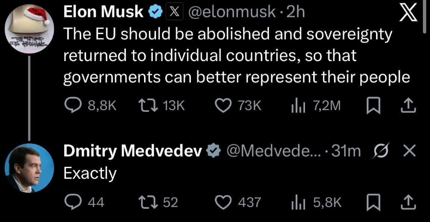
Europe’s only way out is clarity and action. If Donald Trump chooses to undermine the EU, and his envoys refuse to engage with European institutions, that is their decision. But Europe must stop pretending not to see the convergence of pressure from Washington and Moscow. Vice President Vance and Elon Musk posture like saloon cowboys intoxicated by power, threatening the European Commission for enforcing its own laws. At the same time, the Kremlin openly intimidates European political and business leaders – and the Commission itself.
The simultaneity is too obvious to ignore.
The strategic outcome is inevitable, whether Europe wishes it or not. The United States is now openly encouraging far-right parties dedicated to dismantling European integration. How long can Europe maintain the illusion that the shots fired from Washington are any less damaging than those fired from Moscow at European unity? Viktor Orbán now operates with a dual license from Trump and Putin to sabotage EU security policy by “taking under his cover” the European assets of sanctioned Russian companies – despite having no financial capacity of his own. This is precisely the role of brokers of Russian and American interests: to deploy Russian money and collect handsome brokerage fees.
Better a frightening end – in which Europe names the problem and acts decisively – than a slow and painful erosion in which the EU’s geopolitical agony drags on while the Kremlin gains ground daily in the minds of Europeans, regardless of realities on the battlefield.
A cognitive war is raging on two fronts – east and west. Europe cannot afford to lose either.
Ilian Vassilev


