Orbán, Erdoğan, Borisov – and the Attempt to Circumvent the EU Ban on Russian Gas
Hungarian Prime Minister Viktor Orbán’s visit to Turkey on December 8–9 stirred political and strategic tensions across Southeast Europe. Most of the “news” surrounding the visit originated from Budapest – and, tellingly, was not denied by Ankara. Orbán effectively announced that he and President Recep Tayyip Erdoğan had agreed to continue the transit and trade of Russian gas regardless of European Union decisions, including a potential EU-wide ban on Russian gas imports.
It is difficult to imagine a more explicit confrontation between common European policy and the national line of a member state. Orbán insists that he is exercising Hungary’s sovereign right to define its own energy security. Yet a ban on Russian gas would fall under the EU’s common customs policy, which is binding on all member states – regardless of whether they voted for or against it.
This issue directly affects Bulgaria as an external border state of the EU. Bulgarian customs authorities are legally obliged to verify the origin of natural gas entering EU territory and to ensure that it is not Russian. Orbán’s maneuver is transparent – he intends to claim that Hungarian companies have purchased Russian gas in Turkey, that the gas therefore belongs to them, and that it is no longer “Russian.” This is a legal fiction designed to bypass EU sanctions.
Orbán Goes All In
Orbán has chosen to go all in. He has secured political cover from the Trump administration through derogations allowing the import and use of Russian oil and gas. Formally limited to one year, these exemptions in practice represent a direct confrontation with EU law. While the White House stresses their temporary nature, Orbán publicly signals confidence that they can be renewed whenever needed.
Even more puzzling is this strategy given the high probability that Orbán could lose the parliamentary elections in April. One plausible explanation stands out. He appears to be preparing for a political comeback from a position of control over key financial flows beyond the reach of the new Hungarian government. Many Russian oil and gas deals are personally linked to him. Significant portions of the associated revenues remain outside Hungary, allowing influence and leverage even in the event of electoral defeat. In this regard, both Putin and Erdoğan are reliable long-term partners.
“Turkish Gas Mix” or Russian Gas via Turkey
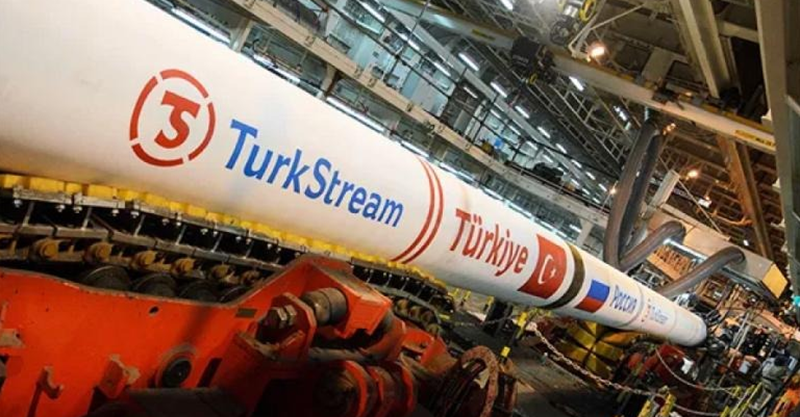
Turkish media quoting Orbán emphasize Hungary’s intention to continue importing 7.5 bcm of gas annually from Turkey – a volume practically identical to the Russian gas Hungary currently receives via TurkStream–Balkan Stream.
Crucially, Orbán explicitly uses the term “Balkan Stream.” This name for TurkStream is used only in Bulgaria and is symbolically linked to Orbán’s long-standing relationship with former PM Boyko Borisov. The terminology itself implies that transit through Bulgaria has already been secured.
Support Independent Analysis
Help us keep delivering free, unbiased, and in-depth insights by supporting our work. Your donation ensures we stay independent, transparent, and accessible to all. Join us in preserving thoughtful analysis—donate today!
More importantly, the transit contracts on Balkan Stream held by Bulgaria’s gas system operator Bulgartransgaz are signed with Gazexport. This implies that Bulgartransgaz would have to agree to transferring these contracts from Russian to Hungarian traders – a detail of decisive importance. Such a transfer cannot occur without the consent of the European Commission, given that it concerns Russian gas or gas whose origin must be demonstrably non-Russian.
At the political and corporate level, this suggests a coordinated decision by Bulgartransgaz, Borisov, Delyan Peevski, and Bulgartransgaz’s CEO Vladimir Malinov to play Orbán’s game against the European Commission.
The narrative that Hungary will import a “Turkish gas mix” via Bulgaria does not withstand even minimal scrutiny. The volumes Orbán cites can enter Bulgaria only through TurkStream, at the Strandzha 2 entry point. Along the entire route from the Russian Federation to that point, there is no deviation from the Russian gas system, which guarantees that it is 100 percent Russian gas.
If Turkey claims it can export its own “gas mix,” the only technical alternative would be entry through the reverse flow of the Trans-Balkan pipeline at the Strandzha entry. Yet that route currently carries less than 2 bcm per year – far below the declared 7.5 bcm. The arithmetic simply does not work.
Bulgaria Between the EU and TurkStream
This context sheds light on Boyko Borisov’s recent maneuvers. He bowed to pressure from Trump by agreeing to block European Commission efforts to use Russian Central Bank assets to support Ukraine. This is clearly an attempt to secure American political protection in anticipation of future divergence from EU policy – both on Ukraine and on the ban on Russian energy.
Whatever Orbán claims, a ban on Russian gas is enforced at the EU’s external border, and Bulgaria is legally obliged to apply it. Bulgarian energy security does not depend on Russian gas, and there is no rational reason for the country to sacrifice European policy in order to serve the interests of a member state deliberately confronting the EU.
Orbán, Ukraine, and the Energy War
Orbán’s actions are not driven solely by domestic energy considerations. The volumes of Russian oil and gas he imports – and the geopolitical context of his strategy – share a common denominator: maximizing damage to Ukraine while maximizing revenue for Russia.
Alternatives to Russian gas exist. Orbán deliberately refuses to use them because he is pursuing a destructive mission against Ukraine and the EU.
Using U.S. sanctions derogations, he trades Russian oil and gas, redistributes them across Central and Eastern Europe, and positions himself as a regional exporter of electricity and gas – including to Ukraine. At the same time, Moscow actively prevents Kyiv from establishing real alternatives for non-Russian gas imports via the Vertical Gas Corridor.
America’s Schizophrenic Position
The paradox is striking. The United States is acting against its own strategic interest by tolerating Orbán’s imports of Russian gas in volumes exceeding Hungary’s needs. This directly obstructs the entry of non-Russian gas – including U.S. LNG – through terminals in Greece and, to a lesser extent, Turkey.
Ukraine’s Response
Ukraine is responding symmetrically. It has not only disrupted Russian oil supplies through the Druzhba pipeline but has also struck Lukoil extraction platforms in the Caspian Sea, whose output is exported via the CPC to the Burgas refinery.
It is only a matter of time before elements of the infrastructure servicing TurkStream are targeted as a response to Russian strikes on the entry points of Ukraine’s gas transmission system linked to the Vertical Gas Corridor. This is war, and such infrastructure is a legitimate military target.
Kyiv has no reason to accommodate Orbán’s interest in continuing to finance Putin’s war chest while Russia systematically bombs Ukraine’s energy infrastructure but leaves entry points from Hungary untouched. The explanation is simple – as long as Budapest controls key electricity and gas flows, Orbán retains leverage over Ukraine. At least in theory.
The energy war is in full swing. Only a naive observer would expect Ukraine to exercise restraint while the TurkStream coalition attempts to circumvent the EU ban on Russian oil and gas. In a war for national survival, Kyiv has no obligation to accommodate Orbán, Erdoğan, or anyone else aiding Putin.
As the saying goes – what goes around, comes around.
Ilian Vassilev