Can Orbán Lose—and Transfer Power Peacefully?
When a leader begins to lose political ground and every polling indicator turns red, the temptation to compensate through manufactured crises and permanent states of emergency becomes not merely visible but increasingly irresistible. This is hardly a new pattern. History offers ample examples of embattled leaders attempting to redirect public attention—from domestic failures to external threats. Variations of this logic are visible today in figures such as Benjamin Netanyahu and Donald Trump, both of whom have relied on a politics of perpetual escalation to sustain political relevance.
Against this backdrop, the recent behavior of Hungary’s prime minister, Viktor Orbán, can be read through a similar lens: an attempt to generate emergencies and then govern through them in a mode of escalating exceptionalism. What he is effectively testing is a model for managing—or obstructing—a transfer of power. If successful, it could offer a template for other illiberal leaders, including beyond Europe.
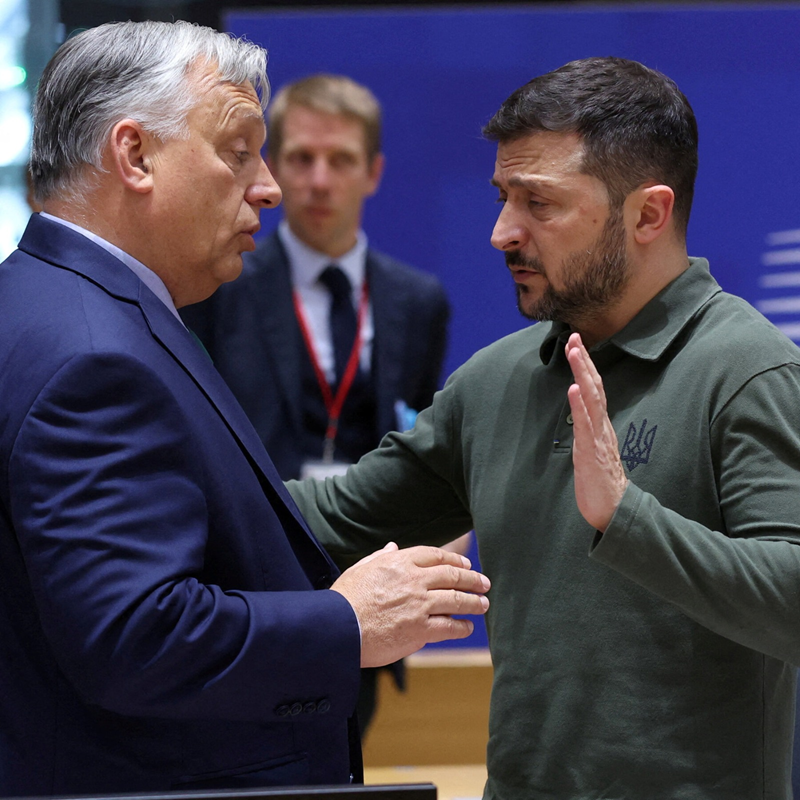
At the core of Orbán’s current political narrative lies anti-Ukrainianism—a constructed threat through which he casts himself as Hungary’s indispensable protector. Ukraine and President Zelensky thus join a familiar roster of adversaries, ranging from George Soros to European Commission President Ursula von der Leyen.
A defining feature of this strategy is the steady amplification of alarmist messaging. Speculative threats to energy infrastructure, insinuations of foreign conspiracies, and even gestures toward military mobilization along Hungary’s border with Ukraine all contribute to an atmosphere of heightened insecurity.
The TurkStream pipeline, in particular, has emerged as a convenient focal point—an asset that allows Orbán to fuse questions of energy security, geopolitics, and national sovereignty into a single, emotionally charged narrative.
The final week before Hungary’s elections is likely to bring yet another “extraordinary” development—designed to push Hungarian society toward a binary choice between security and chaos.
This messaging does not unfold in isolation. Along the entire route of TurkStream, a coordinated pattern of alarmism has become increasingly visible. Russian media outlets have amplified reports of alleged Ukrainian drone attacks on the Russkaya compressor station, followed by claims of planned sabotage targeting the pipeline’s subsea segments in the Black Sea. Yet anyone familiar with Ukraine’s operational record against energy infrastructure will recognize the inconsistency: if Kyiv had intended to inflict meaningful damage, the outcome would likely look very different. Instead, what emerges is a convenient propaganda narrative—one centered on thwarted attacks and neutralized threats that never extended beyond the information domain.
Support Independent Analysis
Help us keep delivering free, unbiased, and in-depth insights by supporting our work. Your donation ensures we stay independent, transparent, and accessible to all. Join us in preserving thoughtful analysis—donate today!
As similar narratives failed to gain traction in the Black Sea region, Turkey, or Bulgaria, the focus has shifted toward Serbia—where Orbán’s ally, President Aleksandar Vučić, presides over a more receptive political environment. There, reports of a purported sabotage plot against TurkStream surfaced at a politically opportune moment—just days before Hungary’s elections and in the most pro-Russian country along the pipeline’s route. The timing is difficult to attribute to coincidence alone and points instead to growing political desperation. The wider Orbán’s polling gap with Péter Magyar, the greater the incentive to escalate.
This dynamic is reinforced by the activation of Russia’s well-established toolkit of political influence. Figures such as Vladislav Surkov—long associated with hybrid warfare and information manipulation—fit seamlessly into such a scenario. His reported presence in Budapest would signal more than routine contact; it would suggest direct Kremlin interest. For Moscow, Hungary increasingly appears less as a fully sovereign European capital and more as part of a broader zone of influence.
In parallel, a sustained campaign has sought to recast Ukraine—and President Volodymyr Zelensky—not as victims of aggression but as sources of existential threat to Hungary. This inversion of causality is deliberate. In this narrative, Zelensky becomes the destabilizing force, while Vladimir Putin is reframed as a partner under pressure.
To some extent, the strategy is working. Opposition leader Péter Magyar, who currently leads in opinion polls, has been forced into a cautious posture on Ukraine, wary of triggering a nationalist backlash that Orbán could readily exploit.
All of this reflects a broader governing logic in which crisis, including spillovers from the Iran war, becomes an instrument rather than an exception. Access to Russian energy becomes the epitome of crisis management.
In the absence of a compelling economic or social narrative, the politics of threat fills the vacuum—not as a clearly defined danger, but as a permanent background condition. And when that narrative begins to lose effectiveness, escalation follows.
This is where the real risk lies—not in any single incident, but in the underlying logic of governance, which leaves little room for a peaceful transfer of power in the event of Orbán’s defeat. A political system that depends on perpetual emergency to sustain legitimacy ultimately becomes a source of instability in its own right.
Hungary has yet to face its own “January 6 moment.” If Orbán were to refuse to concede defeat and instead claim a Trumpian victory, the country could slide into acute internal confrontation. This would undermine the ability of Tisza to form a government and, subsequently, the capacity of a Magyar-led administration to address both domestic distortions and Hungary’s external imbalances. In such a scenario, the convergence of Trumpist and Putinist political logics—polarization, institutional delegitimization, and a readiness to escalate—would take root at the very center of Europe.
This, in effect, is the fallback plan: if Orbán cannot secure an outright victory, Hungary may be pushed toward destabilization—becoming a source of political tremors within the European Union, open to exploitation by both Trump and Putin.
Après Orbán, le déluge. Autocrats rarely exit the stage quietly.
Ilian Vassilev