The Gazprom Cross: Why It Is Russia’s Most Vulnerable Strategic Chokepoint
As Ukrainian long-range strike capabilities expand, the hub at the heart of Russia’s gas system is emerging as one of the most consequential targets in the war.
The war in Ukraine is gradually entering a new phase. During its first years, the central question was whether Ukrainian forces could reach strategic targets deep inside Russian territory. Today, the question is different: which of those targets could fundamentally alter the strategic balance of the war?
One of them is the so-called “Gazprom Cross.”
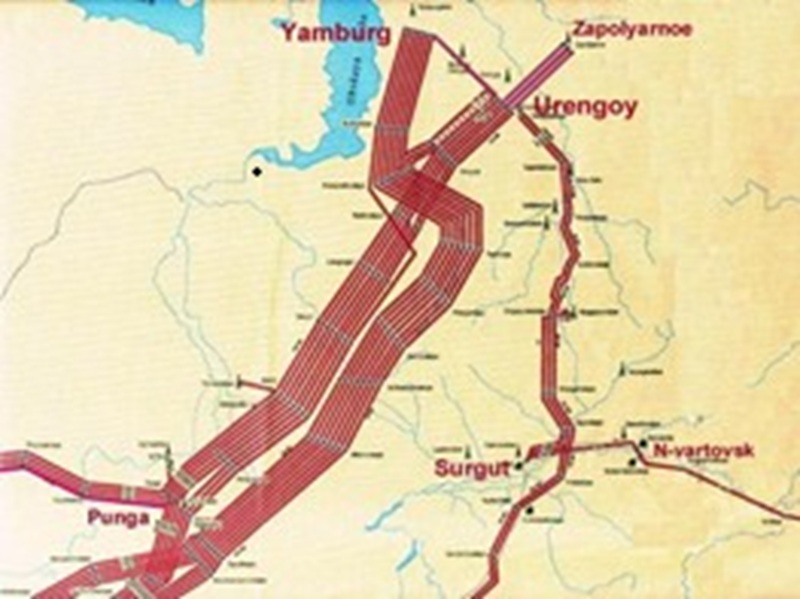
In Russian energy circles, this term is commonly used to describe the area around Novy Urengoy and the network of trunk pipelines in the Nadym-Pur-Taz region of Western Siberia. This is where gas flows from the giant Urengoy, Yamburg, Zapolyarnoye, and newer Yamal Peninsula fields converge. It is no coincidence that Russian officials often refer to Novy Urengoy as the “heart of the gas industry.”
This is not merely another industrial center. It is the central nervous node of Russia’s gas system.
Historically, the Urengoy-Yamburg-Novy Urengoy region has accounted for the majority of Gazprom’s production. Urengoy and Yamburg alone generated more than half of the company’s output for decades. From this system originate – or are supplied – all major export corridors, including Urengoy-Pomary-Uzhhorod, Soyuz, Progress, and Yamal-Europe, as well as critical domestic supply routes serving European Russia.
Support Independent Analysis
Help us keep delivering free, unbiased, and in-depth insights by supporting our work. Your donation ensures we stay independent, transparent, and accessible to all. Join us in preserving thoughtful analysis—donate today!
For this reason, energy experts estimate that between 65 and 75 percent of Gazprom’s gas flows pass directly or indirectly through this network of compressor stations, gathering pipelines, and distribution hubs. For Russia’s domestic market, the share is likely even higher.
In other words, this is not simply export infrastructure. It is infrastructure upon which a substantial portion of the Russian economy depends.
Why Has This Region Suddenly Become Relevant?
Until recently, the answer was straightforward: because it was too far away.
Novy Urengoy lies approximately 2,300-2,600 kilometers from the Ukrainian border. Tarko-Sale is roughly 2,200-2,500 kilometers away, while Purpe is located between 2,100 and 2,400 kilometers from Ukrainian territory. For years, these distances appeared safely beyond the reach of Ukrainian strike capabilities.
But the war has transformed the technological landscape.
Over the past two years, Ukraine has demonstrated an ability to strike targets more than 1,500 kilometers – and in some cases nearly 2,000 kilometers – from the front line. Recent strikes in the Tyumen region have shown that geography can no longer be relied upon as a guarantee of security for Russia’s strategic infrastructure.
Moscow’s concern stems less from Ukraine’s current capabilities than from the trajectory of their development. If the range of Ukrainian systems continues to expand at a similar pace, Western Siberia becomes the next logical frontier.
And that is where Russia’s gas heartland begins.
Why Would a Strike Be So Dangerous?
Russia has already endured numerous attacks on refineries and oil depots. These strikes have imposed significant costs on exports and government revenues, but they have not directly threatened the functioning of the state itself.
The gas system is different.
Natural gas underpins Russia’s heating system, electricity generation, chemical industry, and large segments of heavy manufacturing. Serious disruptions at key transit nodes would not merely reduce export earnings. They would directly affect regional energy supply and cripple the operation of major industrial complexes.
A single strike against a compressor station could likely be managed. However, a sustained campaign against the network of facilities around Novy Urengoy, Purpe, and Tarko-Sale could create severe challenges for both exports and domestic supply.
That is precisely what makes the region so sensitive.
The New Strategic Equation
For years, the Kremlin operated under the assumption that critical infrastructure in Western Siberia was effectively untouchable. This allowed the war to be fought far from the country’s most important energy assets.
Today, that assumption is beginning to erode.
If attacks on oil refineries represent a painful blow to Kremlin revenues, the Gazprom Cross represents a potential strike against Russia’s energy nervous system. Through this network flow not only export volumes, but also a substantial share of the gas that keeps the Russian economy functioning.
This is why recent Ukrainian long-range strikes have generated such nervous reactions in Moscow. They do not prove that Ukraine can already reach Novy Urengoy. They demonstrate something potentially more important: the zone of immunity surrounding Russia’s strategic infrastructure is steadily shrinking.
For Russia’s military and political leadership, that is a deeply troubling prospect.
Because if the war reaches the gas heart of Russia, the consequences could be far more severe than anything the Kremlin has experienced so far.
Ilian Vassilev