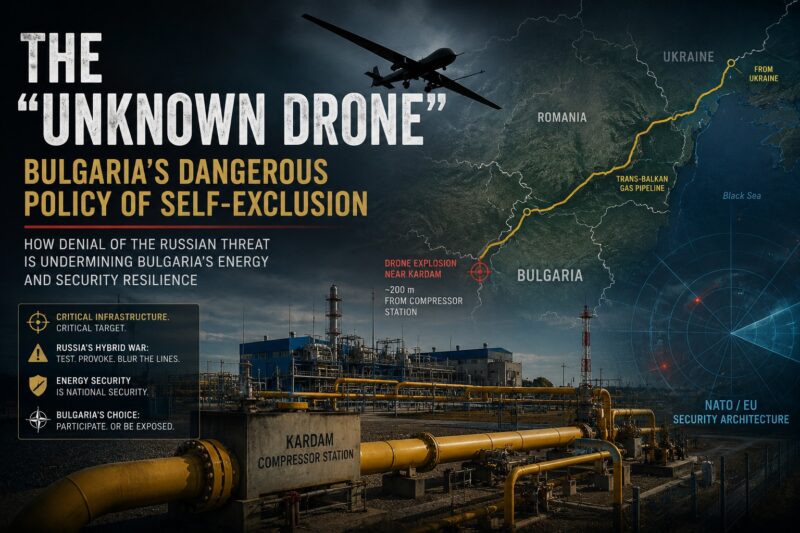
The “Unknown Drone”: Bulgaria’s Dangerous Policy of Self-Exclusion
How denial of the Russian threat is undermining Bulgaria’s energy and security resilience
Everything that defines what might be called Radevism – after Prime Minister Rumen Radev – and its notion of “adequate policy” is now visible in the Bulgarian authorities’ response to the “unknown” drone.
Unknown, perhaps, only to Bulgaria.
Russian drone incursions near Romanian territory and critical infrastructure have become a recurring security problem. The latest incident in Bulgaria is particularly significant: the drone entered Bulgarian airspace from Romania and exploded only about 100 metres inside Bulgaria, roughly 200 metres from a Romanian compressor station and around 1 kilometre from a Bulgarian compressor station on the Trans-Balkan gas pipeline.
The location alone should raise serious concerns for Bulgarian and regional energy security.
From Denial to Strategic Blindness
Russia has repeatedly used drones, including captured Ukrainian ones, in the vicinity of Romanian territory and critical infrastructure, as well as along the borders with Ukraine and Moldova.
The attacks on the Ukrainian side of the Trans-Balkan gas route are particularly relevant. In August 2025, Russian drones struck a compressor station near the Romanian border that was part of the route connecting Greek LNG terminals with Ukrainian gas storage and had already been used for US LNG and test volumes of Azerbaijani gas.
For years, both Radev and Boyko Borissov avoided acknowledging the Russian threat with the seriousness required for a decisive response.
That has consequences. Bulgaria has become the soft spot in NATO’s defense lines.
Once Bulgaria accepts that a drone incident could form part of a Russian hybrid operation, it has no choice but to confront a much more uncomfortable conclusion: that the long-standing policy of “neutrality”, “balance” and “not provoking anyone” may itself have been a strategic misjudgment.
Dependence Is Not Leverage
Bulgaria was also sold another strategic illusion – that dependence on Russian gas transit, or Russian ownership of major industrial assets such as the Burgas refinery, somehow gave Sofia leverage over Moscow.
The slogan, inherited from the era of President Parvanov’s “Grand Slam”, was essentially: independence through greater dependence on Russian gas. The current version should read – greater security through greater vulnerability to Russia.
Support Independent Analysis
Help us keep delivering free, unbiased, and in-depth insights by supporting our work. Your donation ensures we stay independent, transparent, and accessible to all. Join us in preserving thoughtful analysis—donate today!
Yet, history has spoken eloquently. When Gazprom abruptly terminated supplies to Bulgargaz in April 2022, Bulgaria should have understood that dependence and vulnerabilities were asymmetric. Bulgargaz did not have leverage over Gazprom, Russia had one over Bulgaria.
Yet despite this experience, Bulgaria continued transporting Russian gas via TurkStream to Serbia and Hungary, effectively becoming the sole remaining EU entry route for Russian pipeline gas into Europe.
Why the Location Matters
The latest incident becomes more significant when viewed against the broader pattern of attacks on energy infrastructure.
Russia has repeatedly targeted infrastructure that can help Ukraine and Eastern Europe reduce their dependence on Russian gas. The August 2025 strike on the Trans-Balkan route is a particularly clear example: the targeted facility supported a route for US LNG and Azerbaijani gas into Ukraine.
The Trans-Balkan pipeline remains strategically important because its infrastructure can support significant reverse flows and regional diversification, including supplies to Ukraine. It is also part of the broader architecture of the Vertical Gas Corridor.
Energy infrastructure is critical infrastructure. Its vulnerability is a national-security issue.
An Energy System Built Around Russian Transit
For years, Bulgaria invested heavily in infrastructure that consolidated its role as a transit route for Russian gas to Central and Southeastern Europe, while alternative routes remained underdeveloped or underutilised.
Vladimir Malinov, recently removed as CEO of Bulgartransgaz, was one of the key decision-makers during this period. Under his tenure, TurkStream through Bulgaria became the principal route for Russian pipeline gas towards Central and Southeastern Europe.
At the same time, questions remain over the full utilisation of existing Trans-Balkan infrastructure for reverse flows – infrastructure that could form part of the backbone of the Vertical Gas Corridor.
The issue is therefore not merely technical.
It is strategic: whether Bulgaria’s gas infrastructure at a critical time, just months ahead of EU’s full ban on Russian gas, serves primarily the continuation of Russian transit or the creation of a genuinely diversified regional system capable of carrying non-Russian gas, including LNG and Azerbaijani supplies.
And Moscow has demonstrated that it does not intend to observe from the side lines.
Self-Exclusion from Europe’s Security Architecture
The problem for Romania and Bulgaria extends beyond energy.
For Romania, the stakes are particularly high. Gas production from the Neptune Deep project is expected to begin in 2027, making the security of the offshore infrastructure a top priority and a major concern for both NATO and the EU. The growing uncertainty is already reflected in insurance policies covering security risks for operators of the drilling platforms.
In July, Bulgaria declined to join the Coalition of the Willing. Radev argued that Bulgaria’s place was not in a coalition supporting continued military and financial assistance to Ukraine, while maintaining that Bulgaria’s collective security should be addressed through NATO and the EU.
That raises a simple question:
Why Is Bulgaria Excluding Itself from European Initiatives Designed to Strengthen the Very Capabilities Needed to Protect NATO and EU Territory?
European initiatives on ballistic-missile defence are increasingly being developed through coalitions involving Ukraine and European NATO members. The proposed Freyja initiative is one such effort. When asked whether Bulgaria should participate, Radev again pointed to NATO and the EU as the appropriate frameworks.
But Ukraine’s battlefield experience is also becoming indispensable to the development of effective counter-drone capabilities.
Bulgaria therefore risks remaining outside the political formats that are shaping Europe’s emerging security capabilities, while assuming that the resulting NATO and EU architecture will somehow protect it automatically.
That is not strategic ambiguity.
It is a failure of strategic positioning – and ultimately a failure to define where Bulgaria’s security interests lie.
Russia Does Not Need to Attack Bulgaria
Russia does not necessarily need to attack Bulgaria directly to achieve a political effect.
It only needs to demonstrate that it can. The Bulgarian pro-Russian politicians will do the rest.
Russia can test airspace, probe vulnerabilities, generate ambiguous incidents and exploit political divisions. It can repeatedly place NATO governments in situations where attribution is difficult and responses are politically contested.
That is the logic of hybrid warfare. And if Bulgaria responds to every incident with “the drone is unidentified, let’s not jump to conclusions”, Moscow gets precisely what it wants: uncertainty, hesitation and division.
The line between war and peace becomes blurred. The definition of a threat becomes blurred. The readiness to respond becomes blurred. And eventually, so does the credibility of collective defence.
The Real Question Is Not Who Flew the Drone
Bulgaria should not announce Russian responsibility before the investigation establishes the evidence. But neither should attribution become an excuse for strategic paralysis.
The real question is whether Bulgaria is prepared to act before the next incident.
How many more “unknown” drones, incursions and provocations must occur before Bulgaria begins, together with its EU and NATO partners, to build a serious counter-drone and ballistic-missile defence capability?
How many more warnings are needed before critical energy infrastructure is treated as part of the national defence architecture?
And how long can Bulgaria continue demanding proof that every individual incident is Russian while ignoring the strategic pattern in which these incidents occur?
A country does not build security by waiting for the attacker to provide a signed confession.
Nor does it protect itself by hoping that, if it closes its eyes, Moscow will simply pass it by.
That is not a strategy. It is strategic self-delusion.
Ilian Vassilev