
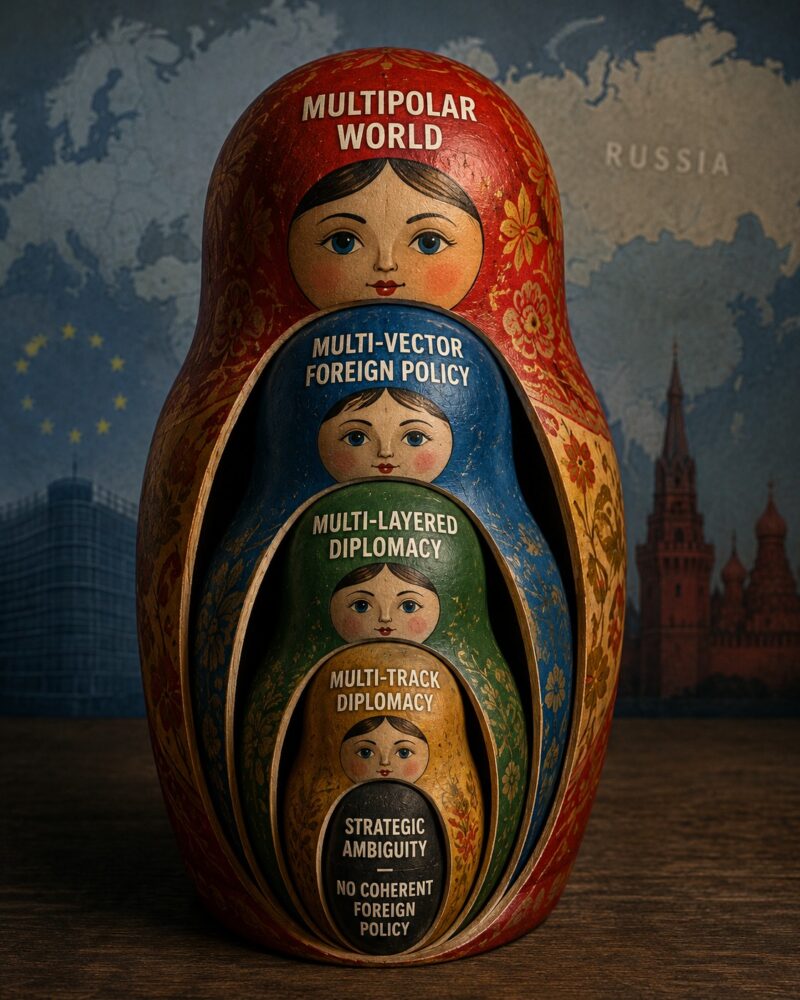
On Multi-Vector, Multi-Layered, and Multi-Voiced Diplomacy
Russian diplomatic neologisms have recently been echoed almost verbatim by the Bulgarian trio of president, prime minister, and foreign minister. Until recently, we were hearing about “multi-vector diplomacy.” Now we are being introduced to “multi-layered diplomacy,” presented almost as an original Bulgarian contribution to the theory of international relations.
The problem is that these concepts mean very different things.
In the academic literature, multi-track diplomacy refers to diplomacy conducted through multiple channels. Developed by Louise Diamond and John McDonald, the concept holds that diplomacy is not carried out solely by foreign ministries but also simultaneously through business, academia, culture, non-governmental organizations, religious communities, the media, and civil society.
A separate concept is layered or multi-layered diplomacy. It describes the interaction among different levels of state policy, security, economics, public diplomacy, and international institutions. While the concept was not introduced by Joseph Nye, it builds upon his ideas about transnational relations, multi-level governance, and the combination of hard power, soft power, and smart power.
The third concept is multi-vector foreign policy. It has nothing in common with the previous two. It emerged in Kazakhstan in the early 1990s and describes a state’s effort to maintain balanced relations simultaneously with different centers of power – Russia, China, the West, and other partners – without becoming dependent on any one of them.
Support Independent Analysis
Help us keep delivering free, unbiased, and in-depth insights by supporting our work. Your donation ensures we stay independent, transparent, and accessible to all. Join us in preserving thoughtful analysis—donate today!
This is precisely the concept that was later incorporated into Russian foreign policy doctrine as part of its vision of a “multipolar world.”
Up to this point, little is controversial. The international system is indeed gradually moving away from the unipolar order once dominated by the United States.
The problem begins with the Russian interpretation of multipolarity, which assumes that Russia itself constitutes one of the world’s major poles of power. Increasingly, however, the facts fail to support such a claim.
Rather than consolidating its status as a global center of power, Russia is steadily evolving into a regional military power with limited capacity to project economic, technological, and political influence. A nuclear arsenal alone is insufficient to sustain claims of global leadership. Its inability to secure a decisive victory in the conventional war against Ukraine, the erosion of its influence across numerous countries and continents, and its shrinking network of allies further constrain its ability to shape the international agenda.
Claiming to be one of the world’s poles cannot be demonstrated through geopolitical treatises. It is measured by economic strength, technological leadership, innovation, financial weight, military capabilities, alliance networks, and the ability to attract rather than merely coerce.
When such measurable indicators are absent, only the claim itself remains.
Russian victories in Ukraine have become increasingly difficult to demonstrate. Economic success stories are becoming progressively harder to substantiate. Perceptions of Russia’s competitiveness in strategic sectors increasingly resemble ideological constructs rather than empirically verifiable realities.
Against this backdrop, a new fashionable term has suddenly become en vogue in Bulgaria – “multi-layered diplomacy.” Not because anyone has developed a new theoretical framework, but because the phrase sounds sufficiently sophisticated to obscure the absence of a coherent foreign policy.
In the Bulgarian political context, the term has begun to function as an intellectual wrapper for attempts to justify departures from the European Union’s common foreign policy. One is left with the impression that one “layer” is intended for Brussels, another for Moscow, and a third for domestic political consumption.
Or, to use a more accurate description, what we are witnessing is no longer multi-layered diplomacy but multi-voiced foreign policy – a situation in which the president, the prime minister, and the foreign minister speak in different languages to different audiences.
That is the real problem. Not the terminology, but the absence of a unified, consistent, and predictable foreign policy. It is also the reason why Bulgaria increasingly appears to be a country that does not formulate its own strategic direction but instead improvises with borrowed geopolitical vocabularies.
Ilian Vassilev


