TurkStream’s Shadow: Bulgaria, Russian Gas, and Europe’s Energy Divide
The Countdown to the EU Ban on Russian Pipeline Gas
With only sixteen months remaining before the European Union’s ban on imports of Russian pipeline gas enters into force, Bulgaria is gradually emerging as a focal point of a broader geopolitical contest—one with high stakes for both the EU and Russia.
Much of the country’s domestic and foreign policy will increasingly be shaped by the legacy of the TurkStream pipeline project—not merely as infrastructure, but as a system of political and economic dependencies.
For years, Bulgarian policymakers repeated the mantra that once a country joins the EU and NATO, its strategic orientation becomes irreversible. Today that assumption looks increasingly fragile, particularly in light of the EU’s planned ban on Russian pipeline gas, scheduled to take effect in September 2027.
The Price of TurkStream
Bulgaria invested billions of euros to build the TurkStream extension across its territory—often referred to domestically as the “Balkan Stream.” In doing so, it effectively sidelined around 18 billion cubic meters of capacity in the Trans-Balkan pipeline system—an infrastructure that today could have supplied Ukraine, Moldova, Romania, Slovakia, and Hungary with non-Russian gas.
Instead, Bulgaria now faces the prospect of substantial financial losses and foregone revenues once the EU ban on Russian pipeline gas becomes reality.
There are several reasons for this.
First, TurkStream—through its Balkan extension—was built almost entirely for the transit of Russian gas. In practical terms, there are few viable alternatives for non-Russian supplies’ capacity take-up, as most pipeline capacity is reserved for Russian exports and the route sources Gazprom gas directly from Russia via the Black Sea and Turkey.
Second, Bulgaria is still servicing the debt incurred to build this infrastructure and has little chance of repaying it before the EU ban takes effect.
Third, the termination of long-term transit contracts with Gazexport and MET will result in the loss of significant revenues that were expected throughout the duration of those agreements.
Ignored Red Flags
For years, analysts warned that tying the project exclusively to Russian gas—and allocating most of its capacity to Gazexport—posed a serious geopolitical risk. These concerns intensified after Russia’s annexation of Crimea and the growing likelihood of further escalation in Ukraine.
Support Independent Analysis
Help us keep delivering free, unbiased, and in-depth insights by supporting our work. Your donation ensures we stay independent, transparent, and accessible to all. Join us in preserving thoughtful analysis—donate today!
Similar warnings were reportedly issued by Bulgaria’s State Agency for National Security to the GERB government led by Boyko Borisov ahead of the project’s final investment decision. Yet these reports were largely ignored. Political ambition and the desire to project geopolitical relevance took precedence over economic logic and long-term risk management.
Brussels Says No
Now that the consequences are becoming clearer, the government of Prime Minister Rosen Zhelyazkov—through former energy minister Zhecho Stankov—has reportedly attempted to link Bulgaria’s support for the EU ban on Russian pipeline gas to compensation from the European Commission for the loss of transit revenues resulting from the early termination of contracts with Gazexport.
The potential losses are estimated in the billions of euros—revenues that would otherwise have been generated until the contracts expired. Without them, Bulgaria’s transmission operator could face serious financial strain.
Brussels’ response was swift and unequivocal.
The European Commission reminded Sofia that when Bulgaria chose to finance and build the project independently, it was explicitly warned that it was doing so entirely at its own risk. For this reason, the pipeline—officially labeled an “expansion of the national gas transmission network”—was removed from the EU’s list of Projects of Common Interest.
Today, Bulgaria has little legal basis to demand compensation—and even less chance of securing it, including through litigation before the Court of Justice of the European Union.
National Interest—or the Interest of Transit?
The deeper paradox lies in how Bulgaria has historically defined its “national interest” in energy policy.
Unlike most EU countries, Bulgaria’s gas strategy has rarely been driven primarily by the interests of domestic consumers. The country consumes roughly 2.6 billion cubic meters of gas annually, yet transits more than 15 billion cubic meters.
As a result, Bulgaria’s positions within the EU have often reflected the priorities of the state-owned transmission operator Bulgartransgaz, rather than those of consumers or industry.
This dynamic became visible in recent months when the Zhelyazkov government instructed Bulgarian representatives in COREPER to abstain during discussions on the regulation implementing the EU ban on Russian gas.
Politically, abstention was the only viable option. A direct vote against the regulation would have placed Bulgaria alongside Viktor Orbán and Robert Fico—and would have openly exposed the failure of the TurkStream strategy.
The Coming Collision with European Energy Policy
The real drama, however, is still ahead.
Instead of developing alternative supply routes and attracting new gas flows to utilize its transmission network, political actors tied to the logic of TurkStream risk pushing Bulgaria into direct conflict with EU energy policy.
The reason is straightforward: without Gazprom transit revenues, Bulgartransgaz’s balance sheet will deteriorate sharply, potentially pushing the company toward a financial crisis similar to that experienced by Bulgaria’s gas supplier, Bulgargaz.
Under such circumstances, Bulgaria may increasingly frame the continuation of Russian gas transit as a “national interest”—aligning itself with the efforts of Moscow and Ankara, as well as with the political agenda of leaders such as Viktor Orbán, to circumvent EU energy restrictions on Gazprom’s exports.
The Borisov–Radev Political Axis
Within this context, the political interaction between former prime minister Boyko Borisov and former president Rumen Radev becomes particularly significant.
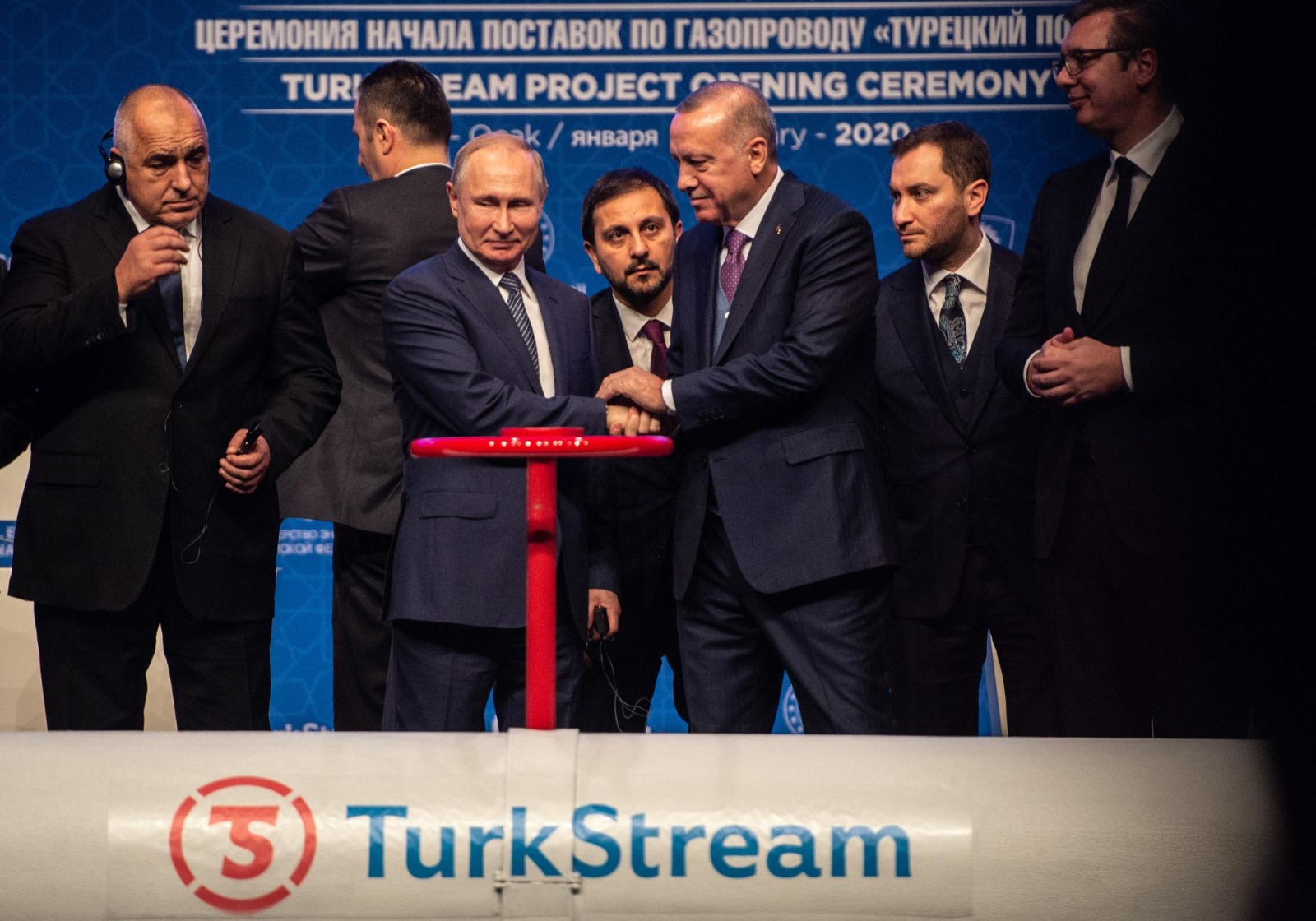
Both figures played a crucial role in providing political cover for the construction of TurkStream at a time when Bulgaria’s parliament lacked strong representation from pro-European democratic forces.
A similar political dynamic could emerge again.
Why Bulgaria Matters to Russia
Few fully grasp how strategically important it is for Russia that Bulgaria continue to serve as a transit corridor for Russian energy exports to Europe.
The stakes are high. And the Kremlin is prepared to use every available instrument to mobilize political influence in Bulgaria—from political leverage to networks of economic and oligarchic interests tied to Russian energy flows.
These networks are already visible in the country’s political arena, including in support of emerging political projects associated with Rumen Radev.
In this complex geopolitical environment, Bulgaria risks becoming a central battleground between European energy policy and Moscow’s strategic interests.
And at the very moment when the future of Russian gas in Europe is being decided, the country finds itself led by a strongly Euroskeptic political figure.
Is anyone really surprised?
Ilian Vassilev