Radev’s Anti-System Rhetoric and Strategic Power Play
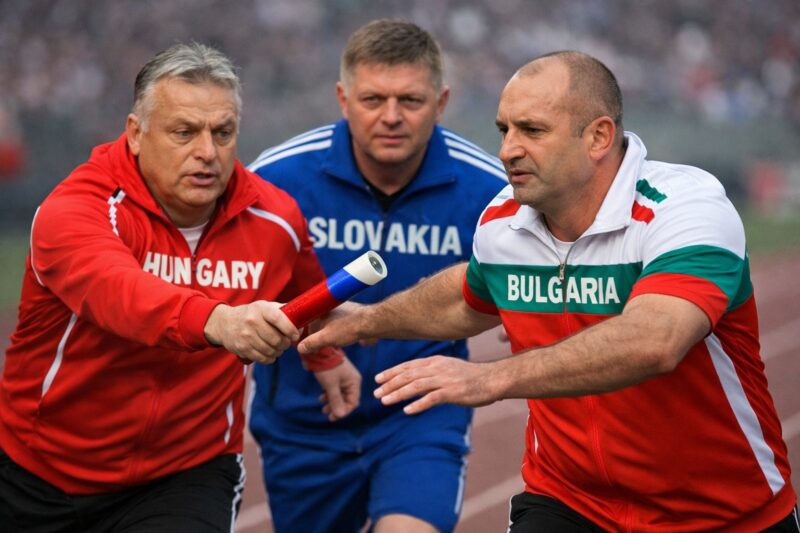
As Bulgaria’s parliamentary election campaign enters its decisive phase, the contours of front runner Rumen Radev’s platform are becoming increasingly clear. The key test of its credibility remains his central promise—to dismantle oligarchy and corruption. Yet this claim increasingly appears to serve as a façade, behind which a different objective takes shape: securing power and, through control of the executive, positioning himself as a potential successor to Viktor Orbán in the Kremlin’s broader European strategy.
Radev casts himself as an anti-system actor—a claim that strains credibility. After nearly a decade at the apex of power, deeply embedded in networks of domestic and external dependencies, he can hardly present himself as an outsider challenging a system of which he is a product—especially when corruption and oligarchic capture are among its defining features.
The Illusion of Outsider Politics
Experience suggests that the system does not allow anyone to reach power unless they have first been accommodated within it. This typically occurs through control over access to resources—financial, media, and human—especially during election campaigns.
The current campaign reflects the opposite of a genuine anti-system profile. True outsiders tend to operate with limited means: modest campaigns, minimal paid media presence, little billboard visibility, and few polished political spectacles. Their strength lies in ideas—often imperfect, sometimes naïve, but authentic.
Radev’s campaign, by contrast, resembles that of Simeon Saxe-Coburg-Gotha—large-scale, well-funded, and professionally managed. Official disclosures are unlikely to capture the full extent of spending; a substantial portion traditionally remains outside formal reporting.
The promise to fight oligarchy sits uneasily alongside the visible markers of belonging to that very system. When a candidate embodies the status quo, claims of dismantling it begin to look less like a reform agenda and more like a bid for a place at the table where power and rents are distributed. In reality, throughout Borisov’s years of dominance in the executive—backed by Peevski and under Radev’s presidency—the central struggle has been over who controls and benefits from the import and transit of Russian energy resources. For the first time, Radev now has a credible opportunity to win elections and consolidate that control through the executive branch.
Energy Policy as a Vector of Geopolitical Realignment
The more consequential issue for Bulgaria, as political positions crystallize, concerns geopolitical and energy orientation. Radev is already outlining his stance, cloaking it in the language of economic pragmatism. His argument that Bulgaria should not be “bound by ideology” within its alliances and should purchase the cheapest available energy effectively amounts to opposition to EU policies aimed at restricting and phasing out Russian oil and gas.
In plain terms, EU support for Ukraine is framed as “ideology,” while dependence on Russian energy is presented as pragmatism. This is not a new line—it closely mirrors the positions of Viktor Orbán and Robert Fico. The same logic has, at different times, guided Simeon Saxe-Coburg-Gotha, Georgi Parvanov, Boyko Borisov, and Delyan Peevski—a policy trajectory that culminated in Gazprom’s unilateral suspension of gas supplies in April 2022.
At present, Bulgaria’s state trader has no active contract for direct imports of Russian gas, making the restoration of such an agreement a likely strategic objective under a future Radev-led administration.
Bulgaria in the Kremlin’s European Calculus
This domestic dynamic must be understood within a broader geopolitical context that helps explain the Kremlin’s interest in Bulgaria’s elections. Should Viktor Orbán lose power in Hungary, Russia would likely seek compensatory influence within the EU. Bulgaria—through a potential Radev victory—could emerge as a relatively accessible alternative.
A single-party government led by “Progressive Bulgaria” appears unlikely, making coalition scenarios inevitable. An alliance with Magnitsky-sanctioned Peevski would carry significant reputational costs, while a partnership with PP-DB would constrain key objectives related to restoring energy dependence on Russia. This leaves one plausible option: open or tacit cooperation with GERB.
Such an arrangement would effectively revive what could be described as the “TurkStream coalition”—a previously uneasy alignment between Borisov and Radev that enabled a major infrastructure project serving Russian gas transit interests.
The Political Economy of the “Cheap Russian Gas” Narrative
At the core of this anti-European narrative lies a familiar claim: that Russian gas is the cheapest and most economically rational option. Historical evidence does not support this assertion. End-user prices have often been higher, while the delivery model has facilitated rent extraction and commission-based political brokerage between the source price in Russia and the final consumer price—benefiting intermediaries and politically connected elites.
The cheapest gas available to Bulgaria remains Azerbaijani, due to a long-term contract indexed to oil prices. This helps explain why its full utilization was systematically delayed and why the Greece–Bulgaria interconnector took more than a decade to complete—unlike TurkStream, which was built with remarkable speed in just one year.
Recent decisions further illustrate this pattern:
- The BOTAŞ agreement, concluded under caretaker governments appointed by Radev, enables the import of a “Turkish blend” of gas with Russian origin via Turkey—a deliberately opened channel likely to be expanded.
- Bulgaria’s shift in COREPER—from supporting a ban on Russian gas after September 2027 to abstaining in the final weeks of Rosen Zhelyazkov’s government—signals a softening of position.
- The retention of key figures in the energy sector, such as Bulgartransgaz head Vladimir Malinov, linked to projects favoring Russian transit and obstructing reverse flows of non-Russian gas through the Trans-Balkan pipeline.
Convergence Rather Than Confrontation
Against this backdrop, the “Borisovization” of Rumen Radev appears to be accelerating. Equally telling is the lack of direct confrontation from both Borisov and Peevski—behavior that is unlikely to be coincidental.
For the Kremlin, a “Borisovized” Radev could compensate—fully or in part—for the potential loss of Orbán. It is therefore unsurprising that pro-Russian propaganda networks are actively supporting his campaign while seeking to discredit his opponents.
Ilian Vassilev