Bulgaria’s Recurring Illusion of a Middle Path Between Europe and RussiaEx-President and future PM Rumen Radev Misreads the Strategic Logic of European Security
What Bulgaria’s new prime minister, Rumen Radev, thinks about Ukraine matters very little to Ukraine itself. Kyiv’s survival does not depend on Sofia’s rhetoric. But Radev’s views matter greatly for Bulgaria – particularly in assessing the risks of self-inflicted geopolitical damage and eventual confrontation with the European Union.
Ukraine has long been the frontline of European security. Whether Bulgarian politicians acknowledge it or not does not alter the strategic reality. This is not a recent phenomenon. Bulgarian socialist thinkers such as Dimitar Blagoev and Georgi Kirkov wrote of Ukraine as a buffer against Russian tsarism more than a century ago. Even Hungary’s Viktor Orbán has admitted that he prefers not to border Russia directly. Any openly pro-Russian policy inevitably enters the realm of national self-defense for European states – Bulgaria included.
The core issue is not that Europe irrationally “hates” Russia or Vladimir Putin after the invasion of Ukraine. Europe’s policy is rooted in strategic self-preservation. Europeans increasingly understand that allowing Moscow once again to weaponize security dependence would expose the continent to recurring blackmail.
Russian history offers a pattern. Successive tsars – and later Soviet and post-Soviet rulers – repeatedly failed to build diversified, prosperous economies. The Kremlin’s most reliable business model has long been commodity exports. When revenues from oil, gas, and raw materials proved insufficient, Moscow often turned to its second business model: that of the European bully and its prime tool – coercion. Threats, military force, and imperial extortion toward Europe have repeatedly filled the gap.
Today, the pattern repeats itself.
Putin has depleted the reserves accumulated during the years of high energy prices. He has failed to modernize Russia’s economy. And now he seeks to impose a new “peace tax” on Europe: pay, or face escalation. The daily nuclear threats against London, Berlin, and even Sofia are not diplomatic messaging; they are part of a coercive doctrine.
In the first weeks of the war, Europe did panic. Governments reviewed contingency plans and recalibrated deterrence postures. Four years later, Europe has become desensitized to Russian saber-rattling. More importantly, European leaders have begun calculating the actual cost of abandoning Ukraine – and the numbers are alarming.
Support Independent Analysis
Help us keep delivering free, unbiased, and in-depth insights by supporting our work. Your donation ensures we stay independent, transparent, and accessible to all. Join us in preserving thoughtful analysis—donate today!
Europe cannot guarantee its own security without Ukraine.
That applies fully to Bulgaria.
The problem with Radev’s circle – and a substantial part of his electorate – is that they do not perceive Russia as a threat and therefore see no reason to invest in defense or align with Europe’s strategic logic.
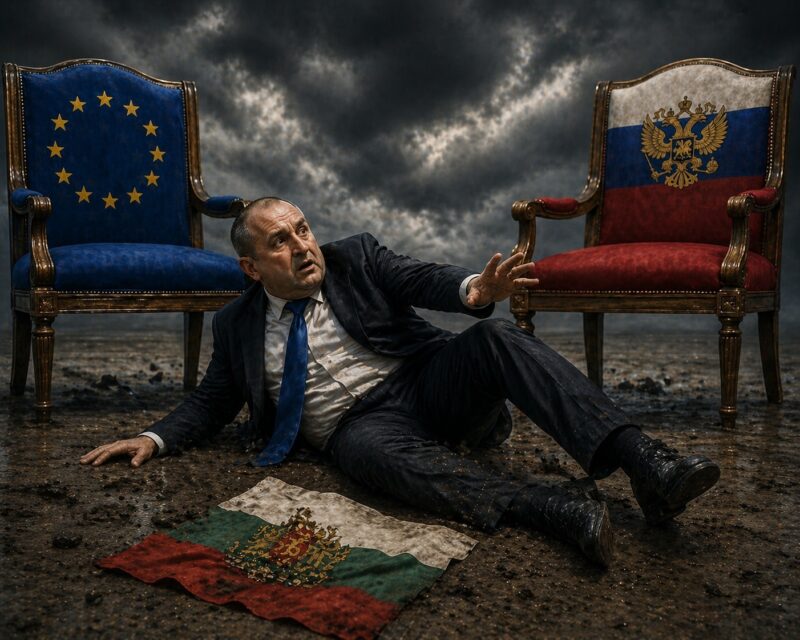
The alternative they implicitly advocate is not new. It is the line Moscow has promoted since the era of Yevgeny Primakov: neutrality, equidistance, and “bridge-building” between Russia and the West. In practice, that means accepting a place within Russia’s sphere of influence and paying a “peace tax” in exchange for temporary stability – while gradually losing access to EU funds, markets, and strategic trust.
This “alternative neutrality” rests on the illusion that Bulgaria can maintain special bilateral relations with Russia outside the EU’s common framework – negotiating energy discounts “without and against Brussels,” profiting as an intermediary in Russian energy flows through projects such as TurkStream, and undermining Europe’s effort to reduce dependency on Russian energy.
Radev likely understands that this is not really about lower prices.
The true concern of these circles is that without Russian energy imports, the Kremlin’s networks of influence in Bulgaria and across the Balkans cannot be financed.
That was the real logic of TurkStream.
The fantasy is familiar: a Bulgarian leader visits Moscow, secures “personal discounts” from Putin, and returns home waving the promise of cheap gas – much like Serbia’s Aleksandar Vučić. Bulgaria’s former prime minister Boyko Borisov promised an “energy grand slam” and delivered TurkStream to Putin – not because it served Bulgaria’s national interest, but because it served as a political insurance premium.
Moscow never gives anything for free. “Cheap” Russian gas often proves expensive once systemic costs are counted. The price at the Russian border may be competitive. Sometimes it is even cheaper than Azeri gas. But the spread between Gazprom’s export price and the delivered price to Bulgaria creates enormous intermediary funds that sustain political oligarchs and Kremlin-friendly networks. This was Orbán’s formula. It was also the formula of Bulgaria’s former president Georgi Parvanov and Borisov.
The same illusion applies to strategic investments.
Germany’s Angela Merkel invested billions in economic ties with Russia and cannot recover them. Bulgaria’s own examples are instructive: Belene Nuclear Power Plant and TurkStream/Balkan Stream.
The European Commission warned Bulgaria in 2017 by removing the pipeline project from the list of Projects of Common Interest. Brussels’ message was clear: if Sofia wanted to proceed against the European interest, it would bear the financial and political risk alone. Today, Sofia complains when Brussels refuses to compensate it for over €2 billion in expected future transit losses. Similarly, Bulgaria lost over €1.7 billion on Belene because it underestimated the political risk of doing business with Moscow.
The underlying mistake is always the same: the belief that geopolitical risk in dealings with the Kremlin can be managed.
It cannot.
No European or world leader – perhaps with the exception of Xi Jinping – can reliably predict or mitgate the geopolitical risk of dealing with the latest Russian tsar.
Ukraine proves this again. By invading Ukraine, Putin destroyed not only parts of Europe’s security architecture but also the European businesses of Russian giants such as Gazprom, Lukoil, and Rosatom.
Bulgaria is paying dearly for these illusions. If Radev continues to pursue a version of “Russian peace,” Bulgaria risks being perceived not as a reliable ally but as a weak link – perhaps even a virus to be isolated. This isolation may not come through formal sanctions under Article 7. It may come through differentiated integration: a Europe of multiple speeds in which only countries aligned with the mainstream remain in the core. Those seeking a “third way” will remain in their own geopolitical limbo.
Radev’s assertion that Russia “cannot lose wars” reflects not strategic literacy but ideological conditioning. History disproves it. Russia lost in Afghanistan. Nuclear powers lose wars; so do the United States.
Today Russia does not possess strategic initiative in Ukraine. That is unlikely to change as the Kremlin confronts the deteriorating condition of its economy. Ukraine, by contrast, has external backing and Europe’s strategic depth.
Bulgaria’s refusal to support Ukraine will not alter the war’s trajectory. It will only squander the political capital Sofia built in the war’s early years. Bulgaria’s defense industry will lose not only an export market but access to military innovation generated on Ukraine’s battlefield. The world is learning from Ukraine. Radev seems uninterested. That is shortsightedness bordering on strategic malpractice or even worse – treason.
The same illusion produces another dangerous argument: that Bulgaria does not need a stronger military and should not “provoke” Moscow. This logic is self-defeating. It suggests Bulgaria can negotiate with the Kremlin and pay for peace rather than invest in defense and NATO commitments.
Ironically, in the one domain where Radev has expertise – the air force – Bulgaria remains dependent on allies to police its airspace. Even Greece at times helps cover regional missile defense contingencies. This is not accidental. It is the result of years of bad policy.
The illusion that Bulgaria can “make a deal” with Moscow is not new. But it reveals a profound misunderstanding of both Russian history and contemporary Russian statecraft. For Moscow, Bulgaria has never been – and will never be – an equal partner. It is a periphery, a tool.
The greatest risk is not a dramatic rupture from Bulgaria’s core economic and defense base – the EU and NATO. It is gradual self-isolation. In search of a mythical middle path, Bulgaria may slowly drift away from Europe’s political and security mainstream.
This deviation will not be loud or explicit. It will be silent, incremental, deniable, and almost invisible – until European alarm systems activate.
The model is Orbán’s Hungary: formally inside the EU and NATO, while steadily undermining both from within in the name of “national interest” and “sovereign democracy.” That is the classic Trojan horse role. And it comes at a price: remaining at Europe’s bottom in prosperity and security.
Bulgaria’s prosperity depends on Europe, not Russia. So does its security. There is always room for political maneuvering – saying one thing in Brussels and another in Sofia. But the price of such duplicity would be ruinous.
For Bulgaria’s security. For its economy. For its prosperity. And for its place in Europe.
After all we live in a glass house.
Ilian Vassilev