Uncategorized

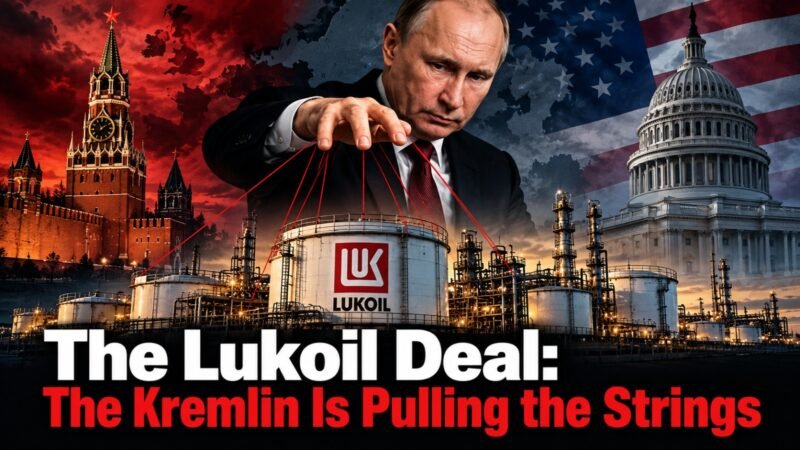
The Lukoil Deal: The Kremlin Is Pulling the Strings

The sale of Lukoil’s international assets has become part of a broader political dialogue between Moscow and Washington. The emerging picture suggests that Putin is using the prospect of major business deals to influence US policy towards Russia and Ukraine.

The most important question surrounding the sale of Lukoil’s international assets is not who will acquire them, but who set the process in motion, who determines its political parameters, and what strategic objectives the Kremlin is pursuing.

Statements made by Yuri Ushakov following Vladimir Putin’s meeting with Steve Witkoff in St Petersburg on 21 October indicate that Moscow views the future of these assets as part of a broader negotiation with Washington. Ushakov placed the sale and sanctions within a wider package of issues under discussion, including major economic projects.

This is a significant signal. The Kremlin does not appear to regard the transaction as an isolated commercial operation, but rather as an opportunity to restore economic ties with the United States.

Lukoil’s international portfolio, initially valued at approximately $22 billion, came under pressure from US sanctions in October 2025. The stated objective was to restrict the Russian energy sector’s revenues and its capacity to support the war against Ukraine. The divestment process has now become entangled with diplomatic negotiations over Ukraine and the future of US-Russian relations.

The abrupt shifts in Donald Trump’s approach to Kyiv raise a fundamental question: is Putin making progress on a major economic transaction part of a broader effort to reshape US policy towards Russia and Ukraine? A direct quid pro quo can hardly be established, as most of the talks are confined to Donald Trump’s personal envoy Steve Witkoff, but the political and commercial dimensions of the process deserve close scrutiny.

Putin Personally Puts the Deal on the Diplomatic Agenda

According to a New York Times report published on 3 October and subsequently covered by Reuters, Putin personally raised the issue of Lukoil’s international assets during his 5 September meeting at the Kremlin with Witkoff and Jared Kushner. The proposal was presented as an opportunity to demonstrate that Russia and the United States could do business together again.

This is a crucial detail. The transaction does not appear to have originated solely with investors attracted by a portfolio of energy assets. According to the published reporting, it was the Russian president himself who introduced the subject into high-level diplomatic discussions.

Although that does not, by itself, establish that the Kremlin designed every element of the acquisition structure it suggests that President Putin is involved in the transaction adding a political dimension that extends well beyond the interests of private buyers and sellers.

The involvement of US investor Todd Boehly and other prospective investors must therefore be examined in this broader context. Following the failure of earlier attempts involving Gunvor and Carlyle to secure an acceptable transaction, the process has continued under intense political and regulatory scrutiny.

The key question is whether the current consortium is merely responding to commercial opportunities or whether its composition and financing have been shaped, at least in part, by political considerations with implications on US policy towards Ukraine.

One revealing feature of the process is the asymmetry in public messaging. Russian officials have repeatedly disclosed details of discussions, while the US side has been considerably more restrained. This leaves room for the Kremlin to shape perceptions of the negotiations and promote the prospect of renewed economic relations without having to disclose the full terms of any emerging arrangement.

An internal Lukoil document I have reviewed indicates that the deal involving the company’s international assets requires prior clearance with Vladimir Putin’s presidential administration. This points to a crucial conclusion: the transaction is not decided solely at the corporate level or driven by commercial considerations. It is subject to political approval at the Kremlin .

This reinforces the argument that the Lukoil deal should be viewed not simply as a business transaction, but as part of a broader geopolitical game in which sanctions, US-Russian relations and Russia’s strategic interests are intertwined.

The distinction matters. The Kremlin may be able to influence the strategic purpose of a transaction without exercising direct control over every investor, financing arrangement or contractual detail.

The Boehly Consortium and the Risk of Business-Politics Entanglement

Public reporting has linked the offer associated with American investor Todd Boehly to Middle Eastern investors and the US government institution DFC, the US International Development Finance Corporation. Connections between some of the participants and business networks associated with Witkoff and Kushner raise questions about transparency and the possible overlap between public responsibilities and private commercial interests.

The issue is particularly sensitive because of Witkoff’s role as Trump’s envoy in negotiations with Moscow. A State Department involvement is expected to advance the national interest, while a Trump envoy and a private investor seek commercial returns. When these roles and interests intersect, legitimate questions arise about whether economic incentives could influence political decisions.

This is not proof of misconduct. It is, however, a reason to demand transparency regarding the investors, beneficial ownership, financing, contractual arrangements and any potential conflicts of interest.

The US Treasury’s Office of Foreign Assets Control (OFAC) has imposed specific conditions on transactions involving Lukoil’s assets. These are intended to ensure that the sale severs the assets’ prohibited connections with the sanctioned company, that payments owed to Lukoil remain blocked where required, and that the transaction does not provide an unauthorised financial benefit to the sanctioned entity. Certain subsequent transactions may also require further OFAC review or authorisation.

At the same time, recent decisions by the Trump administration to ease or extend certain sanctions-related authorisations, including a licence connected with a diesel transaction and extensions affecting the Lukoil asset-sale process, demonstrate that the sanctions framework can be applied with considerable flexibility.

The decisive test is therefore not simply whether a sale takes place. It is whether the transaction genuinely removes Lukoil’s control over the international assets and prevents prohibited revenues from reaching the Russian company, or whether the ownership structure, financing and subsequent restructuring could generate indirect benefits for Lukoil or the Russian state.

Above all, the terms under which OFAC authorises the transaction must be transparent enough to establish that sanctions objectives are being upheld rather than diluted for political convenience.

The potential Trump connection

The potential Trump connection requires closer scrutiny. The proposed investor group, reportedly involving financier Todd Boehly and Middle Eastern capital, should be examined not only in terms of its financial capacity but also for its links to individuals in Putin’s and Trump’s political and business networks. Steve Witkoff, the president’s special envoy, and Jared Kushner, Trump’s son-in-law and former adviser, are particularly relevant because of their roles in the broader Moscow-Washington dialogue and their business interests.

These connections do not, in themselves, establish that the investors are acting for Trump or that the president has a personal financial stake in the transaction. Nor do they prove that the proposed acquisition is linked to US policy towards Ukraine. Their significance is more specific: if the transaction offers commercial opportunities to investors with access to Trump’s inner circle, while its completion depends on sanctions decisions and diplomatic engagement controlled by his administration, the boundaries between business interests and foreign policy warrant close examination.

This is the potential leverage available to Putin. The Kremlin does not need to offer Trump a direct financial benefit for the transaction to acquire political significance. It may be enough for the deal to create an incentive for influential business figures to favour a more accommodating relationship with Moscow. The critical questions are who stands to benefit, what connections exist between the investors and the administration, and whether any political decisions have been linked to the transaction.

US Approval Is Not Enough: British and European Regulatory Hurdles

Even approval from the White House and authorisation by OFAC would not, by themselves, guarantee that the transaction can be completed. The deal also faces sanctions-related and regulatory constraints in the United Kingdom and the European Union.

The UK’s Office of Financial Sanctions Implementation (OFSI) and other relevant British authorities must ensure that any transaction involving assets or entities subject to UK sanctions complies with the applicable rules. In parallel, the relevant EU authorities must address the requirements arising from the European sanctions regime and any applicable national regulatory approvals. The precise permissions required will depend on the assets involved, the structure of the transaction and the jurisdictions in which the businesses operate.

These are not merely procedural formalities. They represent additional points at which the proposed transaction can be delayed, conditioned or blocked. An arrangement acceptable to Washington may still encounter obstacles in London or within the EU if it fails to meet their respective legal requirements.

This is why the sale is far from a foregone conclusion. Political support from the White House may be necessary, but it is not sufficient. Nor can an understanding between Putin and Trump substitute for the independent decisions of the relevant sanctions authorities and regulators.

The Bulgarian dimension adds another layer. Efforts by Trump’s ‘special envoys’ to secure the support of the Bulgarian government may be intended to build local political backing and facilitate the transaction in a country where Lukoil’s assets, particularly the Neftochim Burgas refinery, have major economic and strategic significance. But political support in Sofia cannot replace the required international authorisations, nor can it override British or EU sanctions rules.

The central issue, therefore, is not simply whether the Kremlin can persuade Trump to support the deal. It is whether the proposed ownership, financing and operating arrangements can pass the separate legal and regulatory tests in the United States, the United Kingdom and the European Union. Until those hurdles have been cleared, the transaction remains uncertain, regardless of the political momentum behind it.

Ilian Vassilev

Leave a Reply

Your email address will not be published. Required fields are marked *