
Bulgaria’s Exit from NATO Will Not Come Through the Front Door
The decision by Bulgarian Prime Minister Rumen Radev not to support the initiative for an international tribunal against Vladimir Putin – and especially the reasoning behind that refusal – cannot be dismissed as an isolated diplomatic gesture or a technical dispute over international law. It reflects a broader strategic logic and a consistent political trajectory.
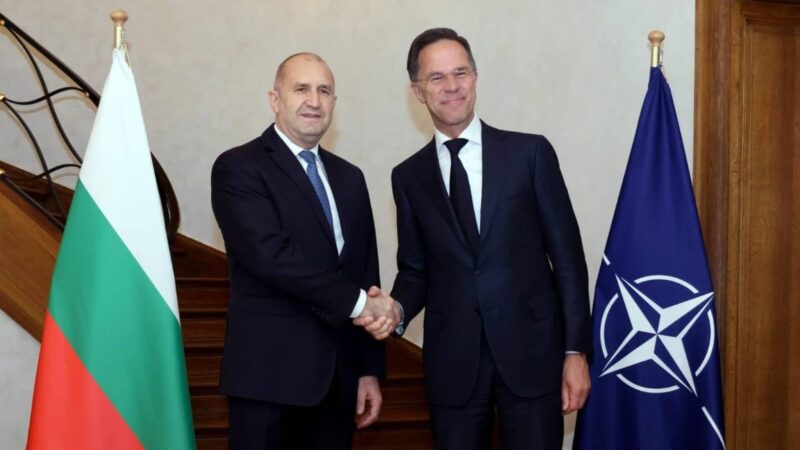
That trajectory was also visible during Radev’s joint press conference with German Chancellor Friedrich Merz. While Merz insisted that Europe must continue supporting Ukraine militarily in order to secure peace, Radev emphasized “de-escalation” in a context that implied limiting military assistance and pressuring Kyiv toward capitulation. Similar messages emerged in a series of interviews ahead of his meetings with French President Emmanuel Macron, Belgian Prime Minister Bart De Wever, NATO Secretary General Mark Rutte, and European Commission President Ursula von der Leyen.
Step by step, Radev is outlining his vision for Bulgaria’s place within the Euro-Atlantic system – one that could ultimately lead to a functional distancing from both the European Union and NATO.
Radev’s formal argument against the tribunal appears cautious and “realistic”: one cannot put on trial the leader of a nuclear power that has neither been defeated nor capitulated and continues to wage war. Yet beneath that position lies a much deeper assumption about the war in Ukraine and the future security architecture of Europe.
At its core, this is an acknowledgment that the Kremlin is not perceived by Radev as a warring party losing initiative, but as a permanent center of power with which Europe will eventually have to negotiate and accommodate. In this worldview, Europe – not Russia – is the weaker actor. Radev therefore approaches the conflict not through the lens of law or morality, but through an acceptance of Russian strength and inevitability – an interpretation increasingly detached from the military, economic, and political realities on the ground.
More importantly, the Bulgarian prime minister has not concealed his willingness to facilitate dialogue between Europe and Putin on terms favorable to the Kremlin.
That is the key to understanding Bulgaria’s potential trajectory inside the EU and NATO under Radev’s leadership.
The Tribunal Question as a Geopolitical Marker
International tribunals after the Second World War did not emerge only after aggressors had already been crushed militarily. The decision to establish the Nuremberg Trials was taken as early as 1943 in Moscow – long before Adolf Hitler was defeated or Germany surrendered.
The logic behind rejecting a tribunal for Putin effectively amounts to the following: Russia is an unavoidable center of power whose channels of influence and negotiation must be preserved. This position mirrors the Kremlin’s own narrative almost word for word – especially in its propagandistic form, rather than in the more pragmatic calculations of some Russian elites around Putin.
Opposition to the tribunal therefore becomes more than a legal position. It becomes a political marker of a broader geopolitical shift.
Ukraine as NATO’s Ultimate Stress Test
The war in Ukraine is entering a new phase. It is no longer simply a war over territory. It has become a test of the resilience of the European security order itself – an order in which Ukraine has become indispensable – and of NATO’s ability to remain a functioning alliance rather than merely a political symbol.
The more the United States withdraws from Europe and the less Europeans can rely on American security guarantees, the greater Europe’s dependence will become on the strongest and most battle-hardened army on the continent – the Ukrainian army.
This is the strategic paradox of the war. For years, many in Europe treated Ukraine as a buffer state somewhere between Russia and the West. Today, Ukraine is increasingly becoming the central pillar of Europe’s future security architecture.
No European army has the combat experience, adaptability, drone warfare expertise, battlefield innovation, or operational scale that Ukraine now possesses. While much of Europe was living in a post-historical illusion, Ukraine redefined the meaning of territorial defense, military resilience, and national mobilization under real wartime conditions.
That is why support for Ukraine is no longer simply an act of solidarity. It is an investment in Europe’s own strategic survival.
And the more uncertainty emerges around Washington’s long-term commitment to NATO – especially under Trump – the more important Ukraine becomes for the balance of power on the continent.
This also explains why Moscow fears not merely a sovereign Ukraine, but a victorious and militarily integrated Ukraine inside the European security system. Because such a Ukraine would fundamentally alter the strategic equation in Europe for decades ahead.
For Putin’s regime, defeat at the hands of Ukraine would represent not only a military setback but an ideological collapse. For years, the Kremlin has built its imperial narrative around the claim that Ukraine is not a genuine nation, that Ukrainian identity is a historical anomaly, and that Russia possesses a “natural right” to dominate the post-Soviet space.
To be stopped by Ukraine itself would shatter the myth of Russian historical inevitability.
This is why the Kremlin constantly searches for new escalation pathways: speculation about Belarus entering the war; hybrid operations and preparations for potential “hot” scenarios against the Baltic states; systematic efforts to undermine European leaders supporting Ukraine; and continuous nuclear brinkmanship and intimidation.
At first glance, such a strategy appears irrational. If one combines Ukraine’s resilience with the collective economic, military, and technological potential of the EU and NATO, the balance does not favor Moscow.
So what is the logic?
First, even in defeat, Putin would rather be remembered as the leader who fought NATO and the “collective West” than as the man who lost to a country the Kremlin long insisted “did not exist.” In that framework, the war can be repackaged domestically as a new “Great Patriotic War” against Western encirclement – a narrative useful for mobilization and political survival.
Second, the Kremlin appears convinced that controlled escalation combined with nuclear blackmail can widen fractures inside NATO. A limited provocation against a Baltic member state – especially around the Suwałki Gap – no longer appears entirely implausible. If Washington reduces its military footprint in Europe and reacts ambiguously to a direct challenge under Article 5, NATO could remain formally intact while becoming strategically hollowed out.
Third, for Putin, the militarization of Russia’s economy and society is no longer a temporary wartime necessity but a condition for political survival. Russian history repeatedly demonstrates that when the internal system begins to crack, the regime seeks salvation through external confrontation. This pattern appeared after the protests of 2011-2012, when the annexation of Crimea restored regime legitimacy. It resurfaced in Syria. And it is now fully visible in the full-scale war against Ukraine.
Fourth, nuclear weapons cannot help Russia win a conventional war against Ukraine. But the Kremlin believes fear of escalation can still function as a psychological weapon against Europe. Ukraine increasingly appears immune to such blackmail. Parts of Europe, however, remain inclined toward accommodation rather than confrontation – as seen in disputes over banning Russian gas or using frozen Russian assets.
Bulgaria as the Weak Link
For years, Radev has consistently built a narrative against “dragging Bulgaria into the war,” against supplying weapons to Ukraine, against sanctions on Russia, and against deeper NATO defense integration. This rhetoric has always been framed as “pragmatism,” “balance,” and “peace-oriented realism.”
Yet in the context of a genuine geopolitical crisis, such language can quickly become an argument for refusing allied solidarity – which in practice amounts to functional distancing from NATO.
Bulgaria does not need to formally leave the Alliance through the front door.
It would be enough to:
- block collective decisions, as Sofia already does on certain Ukraine-related initiatives;
- refuse practical implementation of Article 5 obligations during a future crisis under the pretext of “overriding domestic priorities” and popular resentment of fighting against Russia;
- sabotage collective deterrence projects;
- or begin advocating “neutrality” during an allied confrontation.
Formally, the country would remain inside NATO. In reality, however, membership would gradually be emptied of strategic substance. Once that happens, Bulgaria’s own security guarantees would inevitably lose credibility as well. No country can refuse to honor Article 5 obligations while simultaneously expecting full protection under the same clause – especially while refusing to recognize Russia as a threat.
This is precisely the Kremlin’s preferred model: not dramatic withdrawals from NATO, but the transformation of member states into hesitant, paralyzed, and unreliable actors within the Alliance itself. The next-in-line move – drop sanctions against Russian energy.
The Psychological Preparation
Such a scenario cannot emerge overnight. It requires long-term psychological conditioning.
In Bulgaria, that conditioning is being cultivated through several persistent narratives:
- that NATO membership does not solve Bulgaria’s security problems as the US is leaving Europe;
- that Bulgaria is merely a victim of “foreign geopolitical interests”, which run counter to its ‘national interests” as defined by Rumen Radev’s government;
- that Russia has “legitimate spheres of influence”;
- that neutrality is possible during a major European conflict;
- and that the West is weakening while Russia remains an unavoidable factor.
Another recurring narrative claims that Bulgarians would never allow Bulgarian soldiers to fight against Russia, even if Moscow attacked another NATO member. Since openly maintaining such a position would be politically risky, a subtler approach becomes preferable: keeping Bulgaria’s armed forces underfunded and insufficiently capable so that the country would be objectively unable to contribute meaningfully to collective defense obligations.
This is no longer merely a divergence from the European mainstream on Ukraine. It represents an alternative concept of Bulgaria’s geopolitical identity.
The Illusion of Neutrality
The most dangerous aspect of this strategy is the suggestion that Bulgaria could occupy a comfortable middle ground between East and West.
History suggests otherwise.
Small states rarely succeed as durable geopolitical “balancers” during periods of systemic confrontation. Serbia is an instructive example: Belgrade continues maneuvering between the West, Russia, and China, yet remains trapped in strategic limbo – without a realistic path to rapid EU integration and without a viable alternative.
The illusion of a stable multipolar world – and of alternatives such as BRICS – is colliding with realities emerging from the battlefields of Ukraine and the broader Middle East. The United States may no longer be omnipotent, but no alternative power center has emerged that could credibly replace the Euro-Atlantic system for countries like Bulgaria.
Russia itself is steadily losing both economic and geopolitical weight.
Bulgaria has already made a similar strategic mistake during the Second World War, when attempts to maneuver between great powers ultimately resulted in the loss of national autonomy and decades inside the Soviet sphere of influence.
Today, the risks are different in form but similar in logic.
If Bulgaria begins to be perceived as an unreliable ally, the consequences will not remain abstract:
- reduced access to intelligence sharing;
- delayed and more expensive military modernization;
- declining investment;
- rising geopolitical risk premiums;
- and gradual ostracism within both the EU and NATO.
And this will not happen through an official declaration or dramatic rupture. European institutions have perfected subtler methods of marginalizing states that drift away from the common strategic line. Even membership in the Eurozone or eventual accession to the OECD would not guarantee real influence if Bulgaria becomes excluded from the informal coalitions where the most important decisions are made.
The Strategic Choice Ahead
The real question is whether, on the eve of a new geopolitical storm, Bulgaria will remain anchored within the safe harbor of the European Union and NATO – or whether, under Radev, it will gradually drift away from them and float into a space of uncertainty.
Russia still possesses sufficient resources to destabilize individual European states, including Bulgaria, and to push them outside the political mainstream of the EU. Yet a formal withdrawal from NATO through a referendum or parliamentary decision would involve intolerable political and economic risks even for the most pro-Russian government in Sofia. Such a move would provoke immense domestic and international pressure, economic turbulence, and potentially a severe political crisis.
That is why the only realistic strategy for pro-Kremlin forces is not formal withdrawal, but the gradual hollowing out of NATO membership from within – including effective self-exclusion through the refusal to uphold Article 5 obligations.
Formally, Bulgaria would remain in the Alliance.
In practice, however, it would cease to function as a reliable ally.
And that is exactly the Kremlin’s preferred model: not noisy exits from NATO, but the internal paralysis of member states transformed into hesitant, dependent, and strategically compromised actors from within.
Ilian Vassilev


