Berlin Before Brussels: The Strategic Meaning of Radev’s First Visit
Many will likely argue that it is an exaggeration to draw a connection between Vladimir Putin’s proposal that the European Union appoint Gerhard Schröder as chief mediator in future negotiations over the war in Ukraine and Bulgarian Prime Minister Rumen Radev’s decision to make Berlin his first major foreign-policy destination.
Perhaps. But in geopolitics, symbols are rarely accidental.
What is beyond dispute is that Putin increasingly finds himself cornered and searching for a path out of the war – though strictly on his own terms. To achieve this, he appears willing to activate every available channel of influence, from Donald Trump to Schröder.
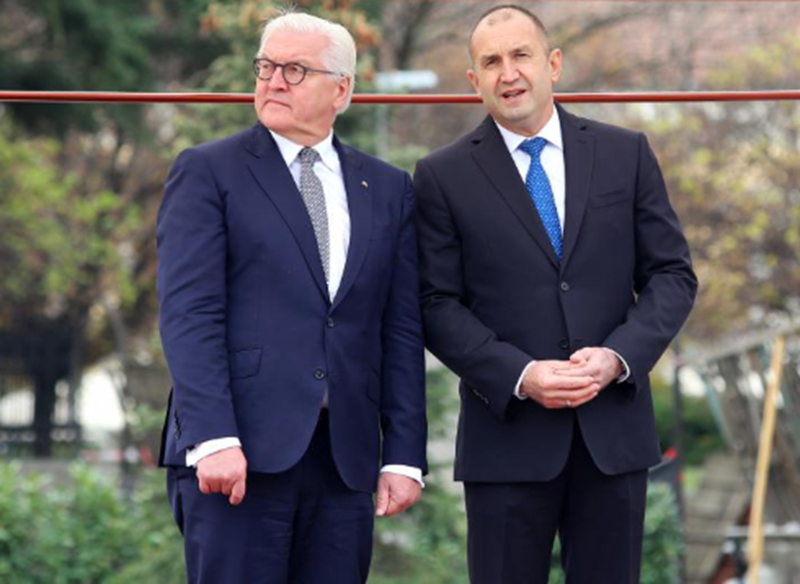
After Putin’s “friendly” suggestion was received in Germany almost as a political provocation – even an insult – the circle of potential German intermediaries quietly expanded beyond the Kremlin’s most overt ally, Schröder, to include the name of President Frank-Walter Steinmeier. At that point, the broader logic became far easier to discern.
Steinmeier was among the principal architects of Germany’s Ostpolitik over the past decade and played a central role in shaping the Minsk agreements – arrangements that ultimately proved too accommodating to Russian interpretations and too weak to prevent full-scale war. Across much of Eastern Europe, he remains emblematic of a German political establishment that believed Russia could be “Europeanized” through economic interdependence, energy ties, and political engagement.
Support Independent Analysis
Help us keep delivering free, unbiased, and in-depth insights by supporting our work. Your donation ensures we stay independent, transparent, and accessible to all. Join us in preserving thoughtful analysis—donate today!
Can a connection be drawn between these developments and Radev’s decision to make Germany his first official visit as prime minister?
Not only can such a connection be drawn – it already exists. Symbolically, geopolitically, and energetically. But it requires careful analysis, because the layers are multiple and simplistic conclusions are often misleading.
The very fact that Radev chose Berlin rather than Brussels as his first major destination is itself a political signal.
There is little doubt that Germany will play a central role in Bulgaria’s foreign policy under a Radev government. Even in 2017, shortly after assuming the presidency, Radev selected Berlin as one of his first major foreign-policy visits, where he met then-President Joachim Gauck and participated in an economic forum with German companies.
Now, as prime minister, his first announced foreign trip is once again to Berlin – this time at the invitation of Chancellor Friedrich Merz.
This can scarcely be dismissed as routine protocol.
Radev has already sent ample signals that he favors a softer line toward Russia and greater distance from the hardline Eastern European approach toward the Kremlin. Precisely for that reason, the boundaries of what will be politically possible under his government will depend to a significant extent on his relationship with Germany and the greenlights he receives from Berlin.
This would hardly be unprecedented.
Boyko Borisov also advanced the most strategically important for Russia TurkStream project through Bulgaria only after receiving encouraging signals from Angela Merkel. Without German tolerance, such a move would have been extraordinarily difficult within the framework of EU policy. Merkel’s political cover was sufficient to blunt stronger resistance from the European Commission.
Germany remains the European Union’s central gravitational force, Europe’s key political mediator, and the state toward which Russian strategy was oriented for decades. Even today, Putin reportedly regards one of his greatest strategic miscalculations as underestimating Germany’s eventual willingness to confront Russia and support Ukraine. Historically, Germany served as Moscow’s principal channel for influencing European politics through energy dependence, industrial ties, and the broader philosophy of Ostpolitik.
This is precisely where the “Schröder-Steinmeier” theme acquires deeper significance.
Radev has consistently demonstrated greater sensitivity to Germany’s political line in Europe than to that of Poland, the Baltic states, or the broader Eastern European bloc. Most recently, he aligned Bulgaria with Slovakia, Hungary, and Malta in opposing the establishment of the Special Tribunal on Russian aggression against Ukraine – a move widely interpreted in Eastern Europe as another signal of his Moscow appeasement policy.
This also is reflected in his rhetoric about “strategic autonomy,” “European solutions,” balancing between the United States and Europe, and in his notably friendlier language toward Russia.
Behind each of these positions lies a careful test of how far deviation from the European mainstream remains tolerable – particularly when that deviation moves in directions more favorable to Russian interests.
An even deeper analogy can be drawn.
Just as Putin appears to be attempting to revive the old German-Russian channel of accommodation through figures such as Schröder and Steinmeier, segments of Bulgaria’s political and economic elite continue to regard Germany as Europe’s ultimate legitimizing center for Russian-linked energy and economic projects.
This leads to the essential question – arguably the most important one for Radev himself.
For his government, a central strategic objective will likely be finding a way around the EU’s future restrictions on Russian gas imports and transit once the new European measures fully enter into force in 2027. One could argue that this is the core geopolitical task expected of him by Moscow and helps explain the extensive support he reportedly received from Russian-linked networks during the election campaign.
Radev does not possess the political base capital of Viktor Orbán to openly position himself as a battering ram for Russian interests inside Europe. He lacks both Orbán’s domestic stability and the international leverage necessary to spend political capital on deeply controversial causes.
That is why it is crucial for him to identify and exploit fractures within European unity on Ukraine and on confronting Russia – particularly through German tolerance, or at minimum tacit German acceptance, of future arrangements connected to Russian gas.
If he cannot secure this directly from Merz, he will likely seek it through other influential German political and business circles.
And time is pressing him. Moscow is pressing him as well.
This explains why he begins his premiership with what may be his most important foreign meeting: Germany.
The Berlin visit is also intended to demonstrate Western legitimacy – something equally necessary on the domestic front, where critics increasingly portray him as a Russian asset. The trip is designed to signal continuity with his presidential positioning while simultaneously conveying that the new government should not be treated as peripheral or isolated.
Yet this balancing act is becoming progressively more difficult.
Radev is not an unknown quantity. His positions on Russia, Ukraine, sanctions, and energy policy are well understood in both Europe and beyond. The space for the kind of “intermediate policy” between Russia and the EU that Borisov successfully navigated during the Merkel era – before the full-scale invasion of Ukraine – has now largely disappeared.
The visit will likely send a message to business circles, energy interests, and institutional elites within the EU that Bulgaria is once again seeking anchorage in Germany’s center of gravity. It is hardly accidental that Radev reacted sensitively to Borisov’s attempt to claim exclusive political credit for the Rheinmetall deal.
But here too, nothing is straightforward.
After the eras of Merkel and Schröder, Germany itself has entered a painful reassessment of Ostpolitik, dependence on Russian gas, and the entire philosophy of “change through trade.” Today’s Berlin is far more sensitive to questions of Russian influence, energy dependence, and hybrid networks.
For precisely that reason, Radev’s visit may ultimately be interpreted in two very different ways:
- as an attempt to secure strong European legitimacy;
- but also as an effort to find a new formula for positioning himself within a profoundly transformed German and European reality.
In that sense, the old formula – “always with Germany, never against Russia” – is becoming increasingly difficult to sustain in a Europe that has fundamentally hardened toward Moscow.
Ilian Vassilev