Analyses & AlternativesFEATURED

The Lukoil Deal: Political Agreement, Financial Engineering and Unanswered European Questions

Why the acquisition of Lukoil’s international assets, negotiated between Moscow, Washington and a private consortium, cannot yet be considered a completed or uncontroversial transaction

On 25 November, Todd Boehly, CEO of Eldridge, announced that he had signed an agreement with Lukoil on behalf of a consortium that includes the US government’s development finance institution, DFC, to acquire the Russian company’s international assets. The announced structure provides for an exchange of Lukoil securities valued at around $10 billion for an international portfolio estimated at approximately $16 billion. The portfolio includes oil and gas assets, refineries in the Netherlands, Bulgaria and Romania, and petrol stations in 11 countries.

At first glance, this appears to resolve a process that has lasted more than a year to sell sanctioned Russian assets. Yet the announced agreement leaves too many undisclosed parameters, contradictions and unanswered questions for the transaction to be described as transparent, final or beyond dispute.

This is not simply an asset sale. It is simultaneously a political operation, a financial restructuring, a sanctions-related procedure and a potential concentration of strategic energy assets in the European market.

1. What exactly is being exchanged, and at what price?

The first question is financial.

According to Reuters, the consortium is acquiring Lukoil securities with a stated value of around $10 billion, which are to be exchanged for the company’s international assets. At the same time, the portfolio is estimated at approximately $16 billion.

This leaves open the question of how the difference between the two valuations has been calculated.

Is the $16 billion figure an independent market valuation of the assets, or an indicative value that does not represent the contractual purchase price? What liabilities, debts, contingent payments or other financial components are included in the valuation? Is there additional compensation that has not been publicly disclosed?

More importantly, Reuters has reported that Lukoil securities were acquired from Western investors and depositary banks. Earlier reports by the agency described purchases of frozen securities at a substantial discount to their indicative market  value.

This raises questions about who actually financed the operation, the acquisition cost of the securities, and the economic gain the consortium may realise by exchanging them for assets valued considerably higher.

It is not enough simply to compare $10 billion with $16 billion. The full financial structure of the transaction must be disclosed if one is to fully assess its financial merit, and all relevant undertakings (including non-monetary, potential future buy-back or other arrangements) by both sides must be disclosed if one is to assess its total impact, including the transactions political consequences.

2. Why the deal is highly advantageous to the Kremlin and Lukoil?

Another key element changes the assessment of the deal: the accounting write-off of Lukoil’s international assets in its 2025 financial statements.

In its consolidated IFRS accounts published on 20 March 2026, Lukoil reported that it had fully written off its investment in LUKOIL International GmbH and recognised an impairment loss of approximately RUB 1.667 trillion – around $20 billion at the current exchange rate of the Central Bank of Russia. The international assets were reported as discontinued operations, while LIG and other foreign entities were deconsolidated from 21 November 2025 following the loss of control.

This write-off does not mean that Lukoil ceased to own the assets or that they lost their underlying economic value. The company states in its accounts that it retained legal ownership of the international assets for the purpose of their sale, disposal or transfer, but no longer controlled their management and no longer had access to material operational and financial information.

Management valued the investment in LIG at approximately zero because of the high uncertainty surrounding the sale, the required sanctions authorisations and the timing of any potential consideration. The company expressly noted that subsequent events, including the completion of a sale, could result in the recovery of part of the written-off investment.

This is where the potential economic benefit of the announced swap emerges. Assets whose accounting value has been reduced to approximately zero may be transferred in exchange for securities with a stated value of around $10 billion. Even if those securities are blocked in an escrow arrangement in the UAE and Lukoil has no immediate access to them, the transaction may provide grounds for recovering part of the previously recognised loss or recognising value that was not reflected in the 2025 accounts.

This does not automatically mean that Lukoil will realise an immediate profit of $10 billion or $16 billion. It is necessary to establish the exact recipient of the consideration, the rights attached to the blocked securities, the conditions for their release, the contractual valuation of the international assets and the accounting treatment of the transaction. Blocking restricts liquidity and access to funds, but does not by itself prove that their economic value is zero – just as the 2025 write-off did not establish that the assets had no underlying value.

The difference between a zero book value and the potential value of the consideration is therefore central to the analysis. The 2025 write-off placed Lukoil’s international assets in an accounting position in which any subsequent recovery of value could have a significant impact on its financial results. The deal does not merely transfer assets to new owners; it may also open a path to partial recovery of value that the company had already written off.

One further question remains: if the securities are to be held in the UAE rather than under US jurisdiction, how will the escrow mechanism be shown to comply with OFAC requirements and ensure that the consideration does not become an economic benefit for the sanctioned company before all conditions have been met? (Lukoil’s 2025 IFRS accounts; Interfax, 20 March 2026.)

3. What does DFC receive, and in return for what?

The participation of the US government’s development finance institution, DFC, is one of the most unusual and openly contentious elements of the operation.

According to Reuters, DFC is to receive an undisclosed equity stake, a share of future profits after private investors have recovered their capital and agreed return, and a seat in the management of the acquired portfolio.

This raises several questions.

What is the exact size of DFC’s stake, and how is it valued? Is the US government contributing capital, assuming financial risk or providing guarantees? Or is it receiving economic rights in return for its institutional participation and the political weight of the US administration?

If DFC is not contributing substantial cash capital, on what basis is it receiving a share of the assets’ future value?

This lack of disclosure does not automatically mean that the structure is unlawful or corrupt. It does mean, however, that public participation must be explained in more detail than a general claim that the US government is providing stability or a protective umbrella for private investors.

There is a difference between a state exercising sanctions authority and a state receiving an economic benefit from a transaction whose authorisation depends on that same sanctions authority. This is particularly relevant because the principal Lukoil assets involved are not located in the United States, while sanctions regimes have also been imposed by the EU and the United Kingdom.

4. Who are the actual beneficiaries?

The publicly announced consortium includes Todd Boehly’s Eldridge, Xtellus Partners, Catena Investment Holding and DFC. Reuters reported that some prospective participants had withdrawn from the process and that Boehly had not disclosed the exact stakes of the partners. This is a significant transparency concern.

Who is the ultimate beneficial owner of Catena Investment Holding, a company based in the UAE? What are the ownership structure and role of Xtellus, the financial firm that emerged after the separation of VTB Capital’s US operations? Who will control the acquired assets once the transaction is completed? Are there investors participating through intermediaries, funds or contractual rights who are not visible in the public structure?

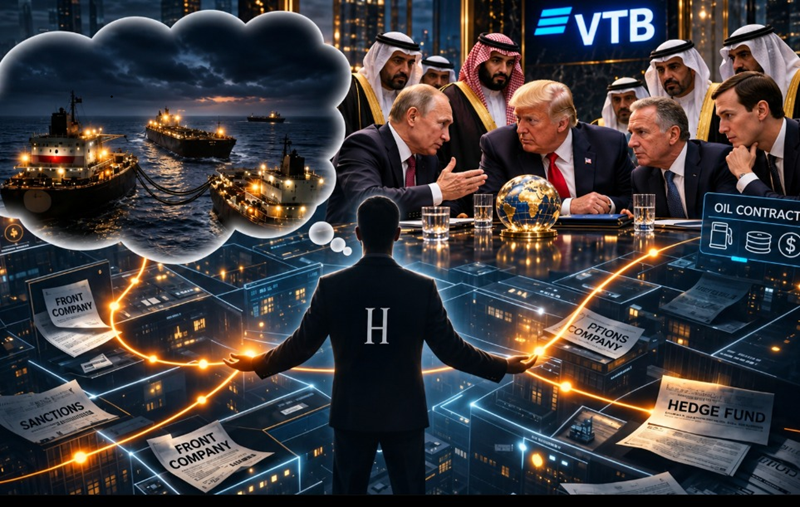
If one were to engage in a more speculative reading of the Eldridge-led consortium, it would be possible to hypothesize that its individual participants could serve as proxies for the major political figures involved and their respective entourages: Boehly potentially representing the mediators, the obscure XTellus possibly acting on behalf of Russian interests, and Catena Investment Holding perhaps serving as a vehicle for the US side.

It is also highly significant that, following Boehly’s announcement of a preliminary deal, Lukoil’s main shareholder declared that “Lukoil has a chance to return to the international market.” If this statement is more than a general expression of hope, it could point to the possibility of some form of buyback option being built into the transaction.

It is particularly important to establish whether side agreements exist that give certain participants veto rights, management control or priority claims on future profits. Could there also be a clause allowing a reverse transaction?

DFC’s participation may lend the deal public legitimacy and institutional weight. But it does not replace the obligation to disclose the ultimate beneficiaries and the actual distribution of economic rights.

Otherwise, DFC’s participation could be interpreted as a façade for the realisation of private and opaque interests or schemes.

5. How does the deal fit with OFAC’s publicly stated conditions?

This may be the most important legal question.

On 19 November, OFAC published updated guidance concerning the sale of Lukoil’s assets. The US sanctions authority stated that any future authorisation would have to meet at least three conditions:

  • all links between the international assets and Lukoil must be fully severed;
  • funds owed to Lukoil must be blocked in an account under US jurisdiction until sanctions are lifted;
  • Lukoil must not receive an unexpected economic benefit, including through the advance provision of value or an exchange of assets and shares.

Yet the announced deal provides for an exchange of Lukoil securities for its international assets, with the securities to be held in an escrow arrangement in the UAE.

This creates a specific apparent inconsistency that requires an explanation.

How can an escrow arrangement in the UAE be reconciled with OFAC’s requirement that funds owed to Lukoil be blocked under US jurisdiction? How will it be ensured that the exchange of securities does not provide an economic benefit to the sanctioned company? What exactly will Lukoil be able to receive, and under what conditions – particularly given the possibility of recovering real value after the assets were fully impaired and written off as an accounting loss?

This is not a technical detail. It lies at the heart of the sanctions logic of the transaction.

6. Why must European and British sanctions authorities be involved?

OFSI has already extended the licence permitting certain business operations with Lukoil’s Bulgarian companies, including the Burgas refinery, until 26 February 2027.

That licence, however, permits the continuation of specified activities. It does not constitute approval of the sale of the international portfolio, nor does it settle the question of future ownership of the refinery.

The same applies to US sanctions authorisations: they are necessary for activities that would otherwise be prohibited under the sanctions regime, but they do not replace EU competition review, national regulatory procedures or requirements relating to the security of critical infrastructure.

The question must therefore be asked: will European and British institutions assess the transaction independently, or will they face political pressure to accept a structure already negotiated between Moscow, Washington and private investors?

7. DG COMP and the competition implications of the acquisition

A separate question is whether the acquisition is subject to European merger control.

DG COMP does not issue sanctions licences. Its remit is to determine whether the acquisition of control over businesses or assets constitutes a concentration with an EU dimension and whether it could significantly impede competition.

It is likely that the wider transaction meets the EUMR thresholds, therefore the European Commission might have an exclusive competence under the Regulation. If it does not, the transaction may fall within the CPC’s jurisdiction, while referral mechanisms may also be relevant. In the Lukoil case, however, the competition issue is particularly important.

The Court of Justice of the EU has already considered Bulgarian cases in which it was noted that the Lukoil group spans the entire chain of fuel production and sales, while the Burgas refinery is the only refinery in Bulgaria. Court materials have also described the group’s unique logistics, storage and transport infrastructure, as well as its significant market position and influence on the regional market, including in several EU countries.

The acquisition therefore cannot be assessed merely as a change of ownership of individual assets.

It must be established whether the new consortium will acquire control over a market position that has a substantial influence on fuel supply in Bulgaria and the region. It is necessary to analyse whether vertical integration, access to port and storage infrastructure, and control of the refinery could restrict competition or place independent importers at a disadvantage.

Burgas’s substantial influence on the regional market is not merely an argument for the refinery’s strategic importance. It is a reason to examine the actual competitive consequences of the acquisition.

8. The political sanctioning of the deal by Moscow and Washington

Lukoil announced that it had entered into a preliminary agreement. According to information available to us, this was done with the explicit prior approval of the Putin administration. If confirmed, this means that the Kremlin is not a passive observer of the operation but is directly involved in framing it politically.

Reuters reported that the agreement was signed by a consortium including DFC and that its completion depends on OFAC authorisation.

This creates a political structure in which the Russian side permits strategic assets to leave the company’s international corporate structure, the US government participates through a financial institution, and private investors acquire the assets and their future value.

Reports have also indicated that Trump’s special envoys, Steve Witkoff and Jared Kushner, were involved in the negotiating process, including in meetings with Putin and his special representative, Dmitriev.

This does not in itself prove an unlawful arrangement or the existence of hidden beneficiaries. But it raises the question of whether the deal is the result of an independent market process or a politically negotiated operation implemented through private financial intermediaries and potentially benefiting political figures. It also raises the possibility of trading in influence.

If the latter is the case, European institutions must know exactly what is being negotiated and what economic and strategic consequences their decisions will have.

Neither the United Kingdom nor the European Commission is obliged to approve the deal, even if OFAC issues a special licence.

9. Why the deal remains controversial

The deal remains controversial because the publicly announced terms do not answer the fundamental questions concerning:

  • the actual contractual price and valuation of the assets;
  • the origin and acquisition cost of the securities;
  • the size of DFC’s stake and the rights attached to it;
  • the ultimate beneficiaries and the distribution of economic rights;
  • the compatibility of the exchange with OFAC’s publicly stated conditions;
  • the jurisdiction and control of the escrowed securities;
  • EU merger review and the competitive consequences;
  • future control over critical energy assets in the EU;
  • the possibility of partially recovering the value of the international assets written off in 2025;
  • any future arrangements to transfer ownership and/or control back to Russia.

These are not secondary issues. They determine whether the transaction represents a transparent exit by a sanctioned Russian company from its international assets, or a complex operation in which sanctions, state participation and private financial interests are intertwined in ways that have not yet been publicly clarified.

Europe cannot remain a passive bystander

Lukoil’s international portfolio includes assets that are essential to European energy security and regional fuel supply. Bulgaria is a particularly sensitive case because of the Burgas refinery and its role in the national and regional market.

If the US government receives an economic stake in the transaction while European countries remain primarily regulators and hosts of the assets, a legitimate question arises about the political and economic asymmetry of the operation and the possibility of non-market benefits for the US side.

US sanctions authority does not automatically create a right to ownership. EU sanctions likewise do not give the EU or its member states a right to a share in the acquisition. But European institutions have a duty to protect competition, transparency and the security of critical infrastructure.

The deal should therefore not be assessed solely through the lens of whether it receives OFAC authorisation.

It must also be scrutinised by European competition authorities, national regulators and institutions responsible for energy security.

The question is not only whether the deal was expediently politically negotiated before the composition of Congress changes, whether senior political figures stand to benefit from it, or whether those or other such figures are pressuring Ukraine into accepting Putin’s demands.

The 2025 accounts make this issue even more significant: Lukoil reduced its investment in LIG to approximately zero, but the company itself acknowledges that a subsequent sale could recover part of the written-off value. The review of the transaction must therefore examine not only the price and sanctions mechanism, but also how the blocked consideration could restore economic value to the seller.

The central question is whether the publicly announced structure is sufficiently transparent, legally compliant and compatible with competition rules to be approved by the institutions responsible for the European market and energy security. Until these questions receive public and verifiable answers, the deal cannot be presented as a definitive resolution of the issue of Lukoil’s international assets. It marks the beginning of a new phase – one in which the financial structure, sanctions framework and control of strategic assets must be independently scrutinised.

Ilian Vassilev

Leave a Reply

Your email address will not be published. Required fields are marked *