
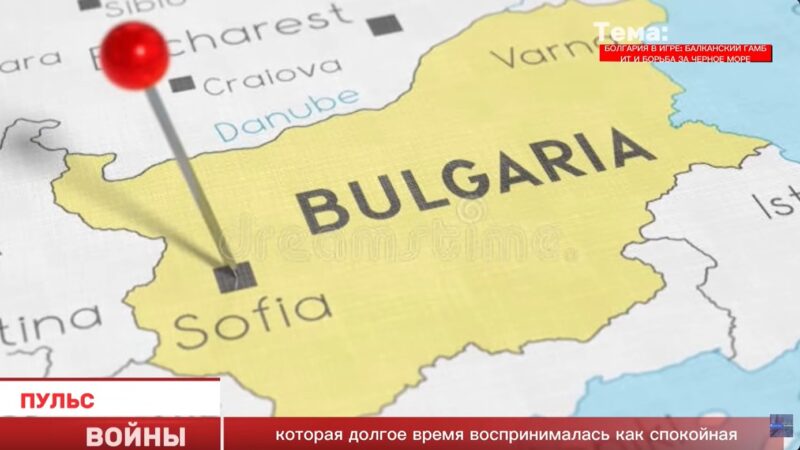
When Propaganda Speaks: How the Kremlin Sees Bulgaria After Radev
Energy, Influence, and Hybrid Strategy in a Narrowing Strategic Space
A recently released propaganda video—produced with the involvement of structures close to the presidential administration in Russia and circulated through networks under its influence—offers more than messaging. It offers a window into intent.
Such material is rarely just rhetorical. With sanctions constraining official channels between Russia and the European Union, overt diplomacy has limited reach. What remains is the domain of hybrid influence—information operations, narrative shaping, and political signaling. This video belongs squarely to that playbook.
A close reading yields a clear premise: in Moscow, the political ascent of Rumen Radev is viewed as a strategic opportunity.
Energy as Leverage
At the core of the narrative is a familiar proposition: restoring energy interdependence between Bulgaria and Russia as the foundation for renewed political leverage.
Bulgaria is cast as a pivotal transit hub for Russian pipeline gas, with the expectation that a new government would facilitate continued flows—even under tightening EU constraints and an effective ban. In parallel, the video revives a set of well-worn policy lines:
- efforts to resuscitate the Belene nuclear power project
- renewed imports of Russian nuclear fuel
- reassertion of Russian control over Lukoil assets in Bulgaria
- development of a regional gas distribution hub
None of this is new. It is a recycled agenda from the past decade, unified by a single objective: to rebuild the linkage between Russian resources and Bulgarian dependency.
The Political Arithmetic
The video also reflects a degree of realism about domestic constraints. Moscow appears to recognize that any such reorientation would require significant political capital, that PM Radev does not have.
The implied strategy is one of calibrated balance. On the one hand, the new government would shore up public support through socially oriented—likely debt-financed—measures. On the other, it would rely on media influence to manage dissent and contain scrutiny. The aim is to create sufficient political space to pursue steps aligned with Russian interests without triggering immediate backlash.
Support Independent Analysis
Help us keep delivering free, unbiased, and in-depth insights by supporting our work. Your donation ensures we stay independent, transparent, and accessible to all. Join us in preserving thoughtful analysis—donate today!
In effect, this is a model of gradually converting political capital into geopolitical alignment—paced carefully to preserve domestic legitimacy.
Preparing the Ground: Framing Europe as the Other
No such shift can occur without reshaping public perceptions. The narrative anticipates the activation of familiar frames:
- “national interest” versus “Brussels”
- “sovereignty” versus “external pressure”
These are designed to legitimize policy choices aligned with Russian energy priorities by presenting them as expressions of Bulgarian sovereignty.
A parallel strand is a sustained current of anti-Ukrainian messaging, aimed at eroding support for Ukraine and weakening the cohesion of the EU’s position.
The Limits of the Strategy
For the Kremlin, the problem is that its underlying assumptions are increasingly detached from reality.
Russia’s position has weakened—economically and militarily, including in its war against Ukraine. Its capacity to project power in the Black Sea region is constrained, while domestic economic pressures are mounting. At the same time, a transition of power in Moscow appears to be underway—hardly the backdrop for a coherent or successful effort to realign Bulgaria’s policy.
In this context, the relative openness of the messaging reflects not confidence but constraint. Hybrid influence remains one of the few tools still available to the Kremlin, yet even this instrument is increasingly blunted by the erosion of Vladimir Putin’s authority.
NATO, the Region, and Bulgaria’s Strategic Role
The video advances a broader geopolitical claim: that a shift in Bulgaria could erode NATO’s southeastern flank.
The mechanisms are familiar:
- slowing or obstructing military modernization through arguments that prioritize social spending over defense
- fostering friction with neighboring states, Serbia, RNM, including Romania, which is more deeply integrated into NATO structures
- undermining trust in collective defense by questioning the credibility of Article 5 guarantees
The intended conclusion is clear: Bulgaria cannot rely fully on its allies and should therefore pursue a more “balanced” engagement with Moscow.
Manufacturing a Parallel Reality
These videos do not describe reality—they attempt to construct one.
This is a classic technique: building a parallel narrative to bridge the gap between ambition and constraint. It is meant to sustain expectations of relevance and influence even as material capabilities decline.
Bulgaria remains important in Russian strategic calculations, particularly as Moscow’s position erodes elsewhere in the region. But importance does not equal feasibility.
Signals and Constraints
The value of this propaganda lies less in what it claims than in what it reveals. It shows how Moscow thinks, what it wants, and where it sees opportunity.
It also reveals the limits of those ambitions.
In today’s European environment, deviations from the EU and Euro-Atlantic mainstream are no longer treated as manageable divergence. They are increasingly viewed as systemic risk. Tolerance for “exceptional paths” has narrowed significantly after Orban.
For any Bulgarian government—even one with a strong parliamentary mandate—the political cost of pursuing such a course would be high and likely unsustainable.
In an era of accelerated political cycles, the distance between support and backlash has shortened. That is the constraint within which any strategy—domestic or external—must now operate.
Ilian Vassilev


